







ビジネスハブアジアロゴ
接触
戻る

Introduction: Why SNI Certification Is the Key to Indonesia’s Consumer Market

4月 22, 2026

8分で読めます

SNI Certification for Electronics in Indonesia: The 2026 Importer's Guide

コンテンツ

Indonesia is one of the most dynamic consumer markets in Southeast Asia, home to over 270 million people with a rapidly growing appetite for electronics and household appliances. For any foreign manufacturer or importer hoping to tap into this opportunity, SNI Certification is not simply a formality. 

It is the fundamental legal requirement that determines whether products can clear customs, reach store shelves, and stay on sale.

SNI stands for Standar Nasional Indonesia, or Indonesian National Standard. Managed jointly by the Ministry of Industry (Kemenperin) and the National Standardization Agency (BSN), SNI Certification ensures that consumer products meet Indonesia’s technical safety and quality benchmarks before they enter the market. 

As of 2026, the regulatory environment surrounding this certification has undergone its most significant overhaul in years, making it more digital, more tightly enforced, and more consequential than ever before for businesses that get it wrong.

This guide breaks down everything importers and manufacturers need to know: what has changed, which product categories are affected, how the registration process works, and what risks come with non-compliance.

What Is SNI Certification and Who Needs It?

SNI Certification is a product conformity mark issued by Indonesia’s Ministry of Industry, confirming that a specific product has been tested, audited, and verified against the relevant Indonesian national standard. 

Once granted, it allows manufacturers and importers to display the official SNI logo on their product packaging, which is a legal requirement for all products under the mandatory SNI scheme.

The certification applies broadly across two categories of obligation. Voluntary SNI covers products where the standard exists but compliance is not legally required. Mandatory SNI, however, covers categories where the government has determined that public safety, consumer protection, or market fairness demands strict enforcement. 

For importers and manufacturers of electronics and household appliances, the mandatory category is by far the most relevant.

International companies entering the Indonesian market for the first time often underestimate the scope of mandatory SNI compliance. 

Unlike some regional standards that apply narrowly to a handful of product types, Indonesia’s mandatory SNI list covers a wide range of everyday goods, from televisions and air conditioners to power cables, rice cookers, and detergents.

The 2026 Update: SNI Certification Enters the Digital Era

The most transformative development in 2026 is the full mandatory integration of all SNI Certification applications through the SIINas platform, short for Sistem Informasi Industri Nasional (the National Industry Information System).

Under this new framework, the paper-based, fragmented registration processes that companies relied on in previous years are no longer accepted. Every element of the certification process, from company profile verification and production capacity data to lab test results and factory audit records, must now be submitted, validated, and monitored in real time through SIINas. 

The system creates a single digital thread connecting an importer’s NIB (Nomor Induk Berusaha, or Business Identification Number) to the Ministry of Industry’s verification database.

This shift matters for international companies because it removes much of the informal flexibility that previously existed in the process. Errors that might once have been resolved through supplementary submissions can now trigger automatic rejections or delays within the platform.

Adding to the urgency, the grace period introduced under Permenperin No. 75 of 2024, covering audio-visual and similar electronic devices, expired in June 2025. That means 2026 is the first full year of zero-tolerance enforcement for the updated technical specifications in this category. 

Businesses that have been operating on the assumption that enforcement would remain lenient are now operating in a significantly riskier environment.

Which Products Require Mandatory SNI Certification in 2026?

The following product categories are under active mandatory SNI enforcement in 2026. Any importer or manufacturer bringing these goods into Indonesia without valid SNI Certification faces customs detention, administrative sanctions, or forced withdrawal from retail channels.

Audio-Visual Equipment: Televisions (LED, OLED, QLED, and Mini-LED), digital disc players, and active speakers.

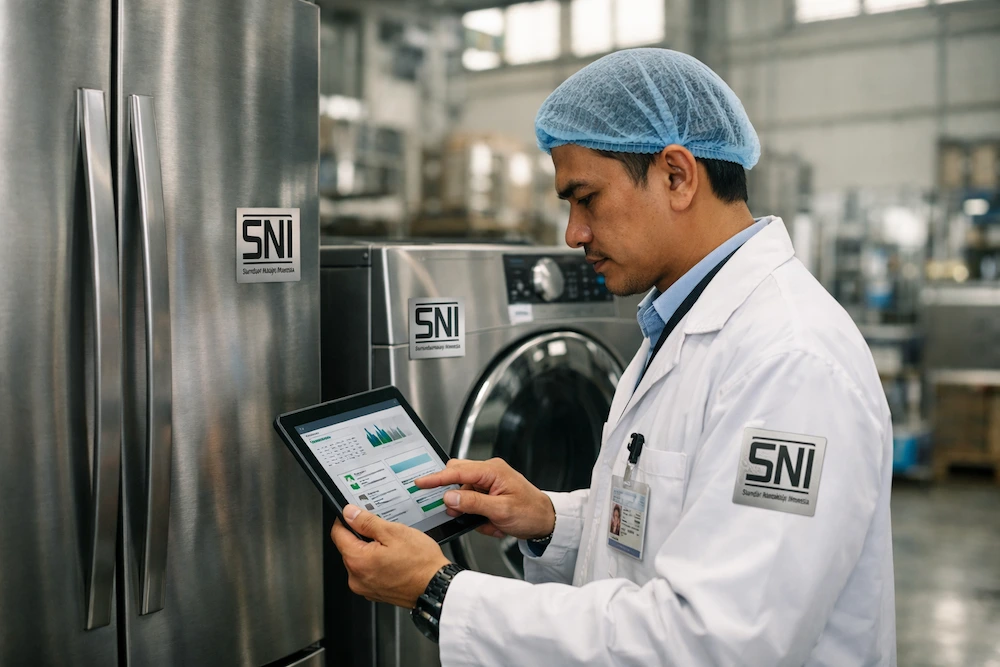
Major Household Appliances: Air conditioners, refrigerators, and washing machines (both top-load and front-load models).

Small Household Appliances: Electric irons, rice cookers, water dispensers, blenders, mixers, and food processors.

Lighting Products: Self-ballasted LED lamps for general lighting and luminaires designed for road lighting applications.

Electrical Components: Fixed and flexible power cables, plugs and socket-outlets, and miniature circuit breakers (MCBs).

Household Supplies: Detergents and household chemicals classified under the PKRT (Perbekalan Kesehatan Rumah Tangga) scheme, as well as certain plastic-based kitchenware items.

It is worth noting that this list continues to evolve. The government periodically expands the scope of mandatory SNI categories, and the most recent amendments, including Permenperin No. 4 of 2026, introduced additional updates to digital certification workflows that affect how some of these categories are processed.

Step-by-Step: The SNI Certification Registration Process

Understanding the procedural steps involved in SNI Certification helps importers plan timelines, allocate resources, and work effectively with local partners. The following reflects the current 2026 workflow.

Step 1: Product Classification and Standard Review The process begins by determining the correct HS Code for the product and identifying the applicable SNI technical standard. This is a critical foundation step. An incorrect classification can invalidate the entire process downstream.

Step 2: SIINas Account Integration Importers must secure an active, verified account on the SIINas platform. All company data, including the NIB, production capacity information, and importer registration details, must be accurate and fully updated. The Ministry cross-references this data at multiple points during the application.

Step 3: Appointing a Licensed Product Certification Body (LSPro) Applicants must engage an LSPro (Lembaga Sertifikasi Produk) that holds current accreditation from KAN (Komite Akreditasi Nasional), the National Accreditation Committee. The LSPro acts as the independent body responsible for verifying compliance against the applicable SNI standard.

Step 4: Factory Audit (Type 5 Certification) For products seeking long-term certification, a physical or hybrid audit of the manufacturing facility is required. The audit evaluates whether a functioning Quality Management System, typically ISO 9001:2015, is in place. Foreign manufacturers hosting auditors from Indonesia need to coordinate this stage carefully, as scheduling and documentation can be time-intensive.

Step 5: Product Sample Testing Product samples must be submitted for testing at a KAN-accredited laboratory located within Indonesia. Overseas test results from internationally recognized laboratories are generally not accepted as a substitute, which means importers must factor in shipping, in-country handling, and testing lead times.

Step 6: SPPT-SNI Certificate Issuance Once the LSPro has reviewed all audit and testing documentation and confirmed compliance, the Ministry of Industry formally issues the SPPT-SNI (Sertifikat Produk Penggunaan Tanda SNI). This certificate is the official authorization to use the SNI mark.

Step 7: NPB Registration and SNI Marking The final step involves obtaining the NPB (Nomor Pendaftaran Barang, or Goods Registration Number) and physically applying the certified SNI logo to all product packaging before import or sale. Both the NPB and the logo are mandatory and must appear correctly on final retail units.

The Real Cost of SNI Certification Non-Compliance

The Indonesian regulatory landscape is known among trade compliance professionals for its sensitivity to documentation errors and its capacity for enforcement that moves quickly once a violation is identified. 

The consequences of non-compliance in 2026 are not merely administrative. They carry real commercial impact.

Customs Rejection and Shipment Detention: Goods that arrive at major Indonesian ports such as Tanjung Priok (Jakarta) or Soekarno-Hatta International without valid SNI documentation are subject to indefinite detention. In many cases, held shipments cannot be re-exported without significant cost.

Legal Sanctions and Blacklisting: The local importer of record bears primary legal liability in most scenarios. Heavy fines and, in serious cases, blacklisting of the importer from future trade activities are documented outcomes for companies that bypass mandatory SNI requirements.

Retail Channel Withdrawal: Indonesia’s largest retailers and e-commerce platforms now actively require proof of SNI Certification for listed products. Goods that fail post-market compliance checks face delisting, which carries both direct revenue loss and lasting reputational damage in a market where the SNI mark is widely recognized by consumers as a safety indicator.

How SNI Certification Builds Long-Term Market Trust

Beyond the compliance obligation, SNI Certification carries real commercial value for brands that approach it strategically. Indonesian consumers are increasingly brand-conscious and safety-aware. 

The SNI logo on a product communicates that it has passed independent third-party verification, which directly supports purchase confidence in retail and online environments.

For foreign brands entering Indonesia for the first time, holding valid SNI Certification for their product range signals credibility to distributors and retail buyers who are accustomed to vetting international suppliers on regulatory status. 

It also simplifies the process of onboarding with major national retailers, which typically include SNI compliance as a baseline supplier requirement.

Conclusion: Treat SNI Certification as a Strategic Priority, Not a Bureaucratic Hurdle

The 2026 regulatory environment makes one thing clear: SNI Certification is no longer a background administrative task that companies can defer or delegate informally.

The full transition to SIINas digital processing, the end of grace periods for key electronics categories, and the sharper enforcement posture from Kemenperin collectively mean that the timeline and complexity of obtaining SNI Certification have both increased.

For electronics importers, household appliance brands, and component suppliers targeting the Indonesian market, the most effective approach is to begin the certification process well ahead of planned shipment dates. 

Working with experienced local compliance consultants who understand the SIINas platform, maintain established relationships with accredited LSPro bodies, and stay current with regulatory amendments will significantly reduce the risk of delays or rejections.

Indonesia’s market rewards those who invest in compliance. SNI Certification is the foundation of that investment.

ファリ・ラマンダ・プトラは、インドネシアの規制関連業務において10年以上の専門知識を持つ一流の法律コンサルタントです。彼は、多国籍企業の複雑なライセンス取得とコンプライアンスを支援し、円滑な事業運営の成功を確実なものにすることを専門としています。.

市場の洞察を常に最新の状態に保つ

ニュースレター購読フォーム

よくある質問

What does SNI Certification mean, and is it mandatory for all products?

SNI Certification (Standar Nasional Indonesia) is Indonesia’s national product conformity mark. It is mandatory for all product categories designated under the government’s mandatory SNI scheme, which includes many electronics and household appliance types. Voluntary SNI exists for categories not yet mandated, but in practice, mandatory SNI covers the vast majority of consumer electronics and appliances.


Can foreign manufacturers apply for SNI Certification directly, or must they work through a local importer?

Foreign manufacturers can initiate the process and prepare the required documentation, including factory audit coordination and sample testing. However, the formal application and all dealings with the SIINas platform and Indonesian authorities are typically conducted through or in partnership with a registered local importer or authorized Indonesian entity that holds an active NIB.

How long does the SNI Certification process take from start to finish?

The timeline varies depending on product complexity, laboratory testing backlogs, and the completeness of documentation at submission. A straightforward application for a single product category typically takes between three and six months. Products that require extensive factory audits or that encounter documentation issues in the SIINas system can take longer.

Do international laboratory test results count toward SNI Certification?

Generally, no. Indonesian regulations require that product sample testing be conducted at a KAN-accredited laboratory based in Indonesia. Some exceptions may exist for certain technical parameters under specific bilateral mutual recognition arrangements, but these are narrow. Importers should not assume overseas test reports will be accepted as equivalent.

What happens if a product's SNI Certification expires while it is already being sold in the Indonesian market?

If a product’s SPPT-SNI certificate lapses without renewal, the importer loses the legal right to continue importing and selling that product. Products already in the supply chain may be subject to withdrawal from sale pending renewal. Indonesian authorities are increasingly active in checking certificate validity dates, particularly for high-volume categories like air conditioners and televisions.

Is there a difference between the SNI mark and the NPB? Do companies need both?

Yes. The SPPT-SNI is the certification document issued to the product. The NPB (Nomor Pendaftaran Barang) is the registration number that must be visibly printed or labeled on each product’s packaging before import or sale. Both are required. The SNI logo without a valid NPB, or an NPB on a product without a current SPPT-SNI, will both result in compliance violations.


Has the SIINas platform made the SNI Certification process easier or more complicated for importers?

The SIINas platform introduces transparency and standardization, which benefits importers who have their documentation in order. However, for companies new to the system, the level of data accuracy required across every field, from NIB information to laboratory test parameters, creates a steeper initial learning curve. Errors that were previously resolvable through supplementary submissions may now cause automatic rejections. Working with a compliance specialist who is experienced on the platform is strongly advisable for first-time applicants.


私たちのチームに連絡してください

弊社が貴社の会社設立や拡大にどのように貢献できるかお知らせください。

お問い合わせフォーム
より迅速な対応と優先的な処理のために、会社のメールアドレスで送信してください。.
お問い合わせフォーム(CN)
より迅速な対応と優先的な処理のために、会社のメールアドレスで送信してください。.

自信を持って東南アジア市場への参入を始めましょう

Business Hub Asiaは、事業ライセンスや製品登録から従業員管理まで、インドネシア、ベトナム、フィリピンの規制遵守をお手伝いします。効率的で正確、そしてビジネス重視のアプローチでサポートいたします。

免責事項

このウェブサイトで提供されるコンテンツは、 PT. ビジネスハブアジア (“「“私たちは"、 または "私たち(以下「本サイト」といいます)は、一般的な情報提供のみを目的としています。掲載情報の正確性と最新性を確保するため、当社はあらゆる努力を払っておりますが、本サイトに掲載されているコンテンツ、製品、またはサービスの完全性、正確性、信頼性、適合性、または可用性について、明示的または黙示的を問わず、いかなる表明または保証も行いません。当該情報への依拠は、ユーザーご自身の責任において行っていただきますようお願いいたします。

私たちは 民間の独立団体 そして 提携関係にない, 承認者、 または 代理として行動する インドネシア共和国政府、その省庁、機関、または公式に任命された代表者。本ウェブサイトは ない 以下を含むがこれに限定されない、政府の公式文書またはサービスを提供、提供、または宣伝すること:

  • 企業識別番号 (Nomor Induk Berusaha – NIB);

  • 税金の還付または払い戻し。

  • 滞在許可証または電子渡航認証。

  • パスポートまたはその他の入国関連書類。

かかるサービスへの言及は、一般的な情報提供のみを目的としており、公式サービスの提供または促進として解釈されるべきではありません。

当社は、お客様の個人情報を以下のとおり保護することに尽力しております。 2022年個人情報保護法第27号当ウェブサイトを通じて収集された個人情報は、[プライバシーステートメント]に明記されている目的のために処理されます。いかなる状況においても、個人データを販売または悪用することはありません。

本ウェブサイトにアクセスし、本ウェブサイトを利用することにより、お客様は本免責事項に定められた条件を承認し、同意するものとします。また、お客様は本ウェブサイトおよび提供される情報を、適用される法令を遵守し、責任を持って利用することに同意するものとします。

この免責事項に関する詳しい情報やご質問については、お問い合わせページに記載されているチャネルを通じて当社までご連絡ください。