








October 2026: The Halal Deadline That Affects Every Consumer Product Category
5 月 8, 2026
•
阅读时间:8分钟
内容
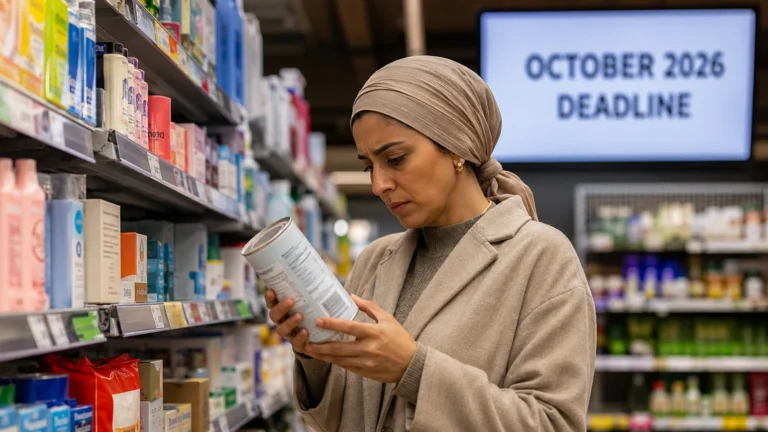
The clock is ticking. By October 17, 2026, every cosmetics brand, food supplement importer, and household health product distributor operating in Indonesia must hold a valid halal certificate Indonesia or risk losing access to one of Southeast Asia’s most lucrative consumer markets.
For foreign companies and exporters who have already invested time and capital into BPOM product registration, this deadline introduces a parallel compliance requirement that carries real commercial consequences.
Indonesia is the world’s largest Muslim-majority country, home to over 230 million Muslims. That market reality has always shaped consumer expectations. Now, it is shaping national law.
Who Is BPJPH and Why They Matter Now
BPJPH (Badan Penyelenggara Jaminan Produk Halal), the Halal Product Guarantee Agency, operates under Indonesia’s Ministry of Religious Affairs. Established through Law No. 33 of 2014 on Halal Product Guarantee (GR 33/14) and further reinforced by Government Regulation No. 39 of 2021 (GR 39/21), BPJPH holds exclusive authority to issue halal certificates for products sold or distributed across Indonesian territory.
Unlike voluntary certification programs found in some international markets, the BPJPH certification mandate is government-enforced. Products found circulating without a valid halal label after the deadline may face shelf removal, customs clearance delays, or administrative sanctions under the JPH Law.
For importers and foreign manufacturers, the message is clear: the halal certificate Indonesia requirement applies to imported goods with exactly the same force as it applies to domestically produced ones. There is no exemption for the country of origin.
Which Products Are Covered by the October 2026 Mandate?
The JPH Law rollout follows a phased timeline. The October 2026 phase specifically targets consumer-facing product categories. The table below outlines current coverage:
| Product Category | Halal Mandatory? | Deadline | Issuing Body |
| Cosmetics | 是的 | October 17, 2026 | BPJPH |
| Food Supplements | 是的 | October 17, 2026 | BPJPH |
| Traditional Medicines | 是的 | October 17, 2026 | BPJPH |
| PKRT (Household Health Products) | 是的 | October 17, 2026 | BPJPH |
| Prescription Pharmaceuticals | Excluded (current phase) | TBD | BPJPH |
| Class II and III Medical Devices | Excluded (current phase) | TBD | BPJPH |
PKRT (Perbekalan Kesehatan Rumah Tangga) covers disinfectants, antiseptics, insecticides, and personal care items classified as household health supplies under Indonesian regulation. Many foreign brands are caught off-guard when they discover their product lines fall into this category. The halal PKRT Indonesia requirement is just as binding as the rules for cosmetics and supplements, and should not be treated as an afterthought.
另请阅读: PKRT Registration in Indonesia: What Household and Home Care Brands Need to Know in 2026
What Halal Certification Actually Requires
Obtaining a halal certificate Indonesia is not simply a matter of submitting a declaration form. It involves a structured compliance review called the Sistem Jaminan Produk Halal (SJPH), Indonesia’s Halal Product Assurance System. The SJPH Indonesia foreign company application process typically involves the following stages:
- Company registration with BPJPH via the SiHalal online platform (see external link 1: BPJPH official portal)
- Document submission, including complete ingredient lists, supplier certificates, production flow charts, and raw material halal attestations
- Raw material audit, covering every component and tracing its source
- Production process inspection, conducted either on-site or via document review. For foreign manufacturers, this typically involves an accredited Halal Inspection Body (LPH) working in coordination with the overseas facility
- MUI Fatwa issuance, where Indonesia’s Ulema Council reviews the audit findings and provides religious endorsement
- BPJPH certificate issuance, the final official document confirming halal status
Foreign companies must appoint an accredited LPH (Lembaga Pemeriksa Halal) approved by BPJPH. These bodies conduct the technical audit, submit their findings to MUI, and only then does BPJPH issue the certificate.
Category-Specific Challenges
Cosmetics
For cosmetics brands, the most significant compliance hurdles involve alcohol-based ingredients 和 animal-derived components. Many formulations use ethanol as a solvent or preservative. Under Indonesian halal standards, the permissibility of alcohol in topical cosmetics is subject to specific conditions and concentration thresholds.
Ingredients such as collagen, elastin, or keratin sourced from non-halal animals will disqualify a product entirely. The mandatory halal Indonesia cosmetics requirement means that reformulation may be unavoidable before any certification application can succeed. This process alone can take several months, so identifying ingredient issues early is critical.
Supplements
The supplement category faces what many in the industry call the “gelatin capsule problem.” The majority of softgel and hard capsule products use gelatin derived from porcine (pig) sources, which is not halal-compliant. To qualify for BPJPH halal certification supplement approval, brands must switch to bovine gelatin from halal-slaughtered cattle, or to plant-based alternatives such as hydroxypropyl methylcellulose (HPMC).
Every excipient, coating agent, flavoring, and preservative used in the product must also be verified for halal status. This level of ingredient scrutiny is more rigorous than what many brands encounter in other markets.
PKRT
PKRT products frequently contain chemical compounds sourced from international suppliers. Establishing the halal status of those compounds, including surfactants, preservatives, and antimicrobial agents, requires tracing the supply chain back to raw material origin. For many foreign manufacturers, this is the most documentation-intensive stage of the certification process, especially when suppliers are located outside Indonesia and are unfamiliar with BPJPH documentation requirements.
How Halal Certification Interacts with BPOM Registration
This is where many importers encounter confusion. BPOM (Badan Pengawas Obat dan Makanan), Indonesia’s Food and Drug Authority, handles product safety registration. BPJPH handles halal certification. These are two separate agencies operating under two separate regulatory frameworks.
However, they are deeply connected at the product label level.
Once BPJPH issues a halal certificate, the official halal label must appear on the product packaging that has been registered with BPOM. If a brand has already completed BPOM registration with a label that does not include the halal mark, a label variation submission to BPOM is required after halal certification is obtained.
Timing is everything here. Applying for a halal certificate import Indonesia without coordinating with the BPOM registration process, or vice versa, can result in rework, additional costs, and potentially missed deadlines. For businesses targeting both compliance milestones simultaneously, an integrated approach delivers far better results.
The January 2026 Draft Labeling Regulation
Stacking on top of the halal mandate is a draft labeling regulation under review by BPOM, proposed for implementation in early 2026. If enacted, this regulation would require product labels to disclose:
- 这 origin of key ingredients (animal, plant, or synthetic)
- 这 alcohol content in cosmetic and topical products, where applicable
- Expanded allergen disclosures beyond current requirements
While the regulation remains in draft form at the time of writing, foreign brands would be wise to treat it as an incoming compliance layer. Designing packaging that satisfies both BPJPH halal requirements and the proposed BPOM labeling rules from the outset will avoid costly redesigns later.
Tracking regional regulatory developments through bodies such as the ASEAN Cosmetics Association is strongly recommended for brands active across multiple Southeast Asian markets.
You might also like: Why October 2026 Is a Hard Deadline for Foreign Brands Under the New BPOM Cosmetic Regulation
Timeline: How Long Does Halal Certification Take?
The realistic processing window for a halal certificate Indonesia, from document submission to certificate issuance, runs between 3 and 6 months. Here is a breakdown:
| Stage | 预计持续时间 |
| Document preparation and gap analysis | 2 to 4 weeks |
| LPH audit scheduling and completion | 4 to 8 weeks |
| MUI fatwa review | 4 to 8 weeks |
| BPJPH certificate issuance | 2 to 4 weeks |
Reverse-Engineering the Timeline for October 2026:
If October 17, 2026 is the compliance deadline, businesses must work backward:
| Action Required | Target Date |
| Begin document preparation and gap analysis | No later than May 2026 |
| Submit BPJPH application and initiate LPH audit | June 2026 |
| MUI review period | July to August 2026 |
| Receive BPJPH certificate | September 2026 |
| Submit label variation to BPOM | September to October 2026 |
Businesses reviewing this guide in mid-2026 are at the absolute edge of the safe window. Any further delays risk non-compliance at the deadline, which could mean suspended product imports, blocked BPOM label approvals, or forced product withdrawal from Indonesian retail channels.
The Commercial Case for Acting Now
Beyond regulatory compliance, there is a compelling business reason to pursue a halal certificate Indonesia proactively. The global halal cosmetics market is projected to reach over USD 93 billion by 2030, expanding at a compound annual growth rate of approximately 12 percent.
Indonesia represents one of the fastest-growing consumer markets in Southeast Asia for halal beauty, wellness, and personal care products.
Brands that secure their halal certification ahead of the October 2026 deadline will be positioned to market themselves as trusted, compliant choices in a market where halal authenticity increasingly drives purchase decisions. Early movers also benefit from faster shelf access, stronger distributor relationships, and competitive advantage over brands still working through the certification backlog.
The halal label is not only a compliance marker. In Indonesia’s market context, it is a trust signal.
How Business Hub Asia Handles Halal and Product Registration Together
Business Hub Asia specializes in guiding foreign companies through Indonesia’s dual compliance landscape: BPOM product registration and BPJPH halal certification. Rather than managing two separate processes through two separate providers, clients work with a single coordinated team that handles document preparation, audit scheduling, ingredient gap analysis, label design review, and regulatory submissions across both agencies.
The team understands the sequencing challenges between BPOM and BPJPH, the category-specific ingredient standards, and the documentation expectations for SJPH Indonesia foreign company applications. Whether a brand is bringing in cosmetics, supplements, or PKRT products, coordinated management of the end-to-end compliance process significantly reduces the risk of costly errors and avoidable timeline overruns.
For businesses ready to move before the October 2026 window closes, now is precisely the right moment to begin.
Closing
October 2026 is not a distant entry on a future planning calendar. For businesses selling cosmetics, supplements, or PKRT products in Indonesia, it is an active operational deadline that demands immediate attention. The halal certificate Indonesia process takes months, and the window to complete it in time is narrowing rapidly.
The good news is that with the right guidance, the journey from compliance gap to certified product is entirely achievable. Every product portfolio is different, and the team builds its approach around each client’s specific regulatory position.
Do not let the deadline catch a business off-guard. Contact us today and take the first confident step toward full halal compliance before time runs out.
联系我们的团队
请让我们知道我们如何协助您的公司成立或扩张。
自信地进入东南亚市场
亚洲商业中心随时准备帮助您了解印度尼西亚、越南和菲律宾的法规,涵盖从营业执照、产品注册到劳动力管理等各个方面。我们采用高效、准确且以业务为中心的方法。
免责声明
本网站提供的内容由 PT. Bisnis Hub Asia (“我们“, 或者 ”我们”)仅供一般参考之用。尽管我们已尽一切努力确保所提供信息的准确性和及时性,但我们不对本网站所述任何内容、产品或服务的完整性、准确性、可靠性、适用性或可用性作出任何明示或暗示的陈述或保证。任何依赖此类信息的风险均由用户自行承担。
我们是一家 私人、独立实体 并且 不隶属于, 授权, 或者 代表 印度尼西亚共和国政府、其各部委、机构或任何官方指定的代表。本网站不 不是 提供、提供或推广任何官方政府文件或服务,包括但不限于:
-
企业识别号(Nomor Induk Berusaha – NIB);
-
退税或返还;
-
居留许可或电子旅行授权;
-
护照或其他与移民相关的文件。
对此类服务的任何引用仅供一般参考,不应被视为官方服务的提供或便利。
我们致力于确保按照以下规定保护您的个人数据 2022年第27号《个人数据保护法》任何通过本网站收集的个人信息,都将按照我们[隐私声明]中明确规定的用途进行处理。在任何情况下,我们都不会出售或滥用个人信息。
访问并使用本网站,即表示您确认并同意本免责声明中所列的条款。您进一步同意以负责任的方式使用本网站及其所提供的信息,并遵守适用的法律法规。
如需了解有关本免责声明的更多信息或有任何疑问,请通过我们的联系页面提供的渠道与我们联系。
你可能还喜欢
随时了解我们关于在东南亚开展业务的最新见解、指南和文章。
产品注册
Health Supplement Registration in Indonesia: A Step-by-Step Guide for Foreign Manufacturers

Dr. Hussein H. Mashhour, MD • 5 月 7, 2026
产品注册
PKRT Registration in Indonesia: What Household and Home Care Brands Need to Know in 2026
Dr. Hussein H. Mashhour, MD • 5 月 4, 2026
产品注册
Why October 2026 Is a Hard Deadline for Foreign Brands Under the New BPOM Cosmetic Regulation
Dr. Hussein H. Mashhour, MD • 5 月 4, 2026