









Health Supplement Registration in Indonesia: A Step-by-Step Guide for Foreign Manufacturers
5 月 7, 2026
•
阅读时间:9分钟
内容
Indonesia’s Supplement Market Opportunity and Why Registration Is the Gateway
Indonesia is one of Southeast Asia’s fastest-growing health and wellness markets. With a population of over 270 million and a rising middle class that is increasingly focused on preventive health, the demand for vitamins, minerals, herbal blends, and functional nutrition products is growing at a remarkable pace.
For foreign manufacturers, this represents a genuine commercial opportunity but entering the market legally means understanding one critical step: health supplement registration Indonesia.
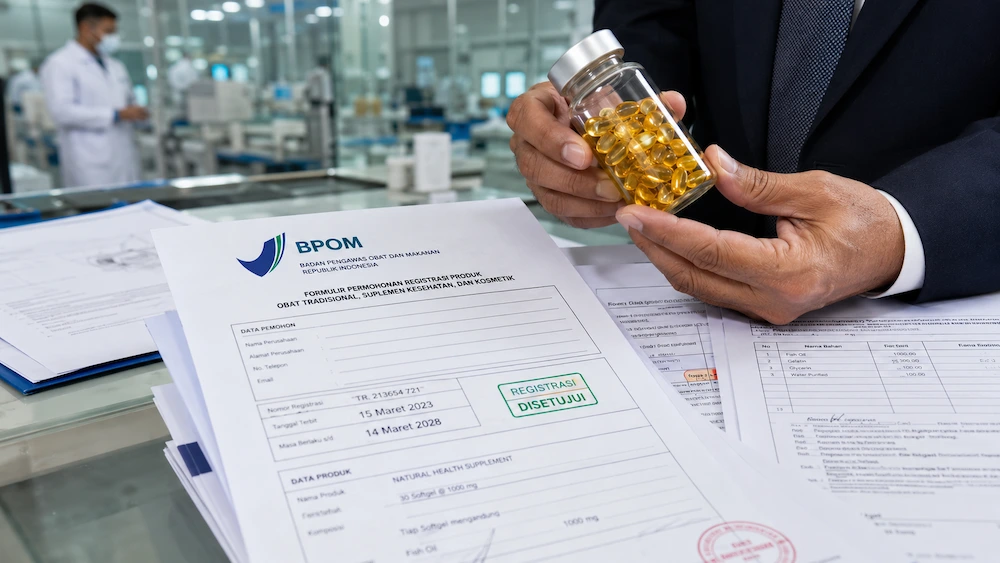
Without a valid distribution permit issued by BPOM (Badan Pengawas Obat dan Makanan), Indonesia’s National Agency of Drug and Food Control, no supplement can be legally imported, marketed, or sold in the country. That is not a barrier; it is a gateway. The brands that navigate registration correctly are the ones that build lasting credibility with Indonesian distributors, retailers, and end consumers.
This guide walks foreign manufacturers through everything they need to know, from regulatory definitions and documentation to timelines, costs, and renewal obligations.
What Counts as a Health Supplement Under BPOM?
Before beginning the BPOM supplement registration process, it helps to know exactly how Indonesian regulations classify health supplements. Under BPOM Regulation No. 11 of 2020 on Health Supplement Criteria and Requirements (11/20), health supplements are defined as products intended to supplement dietary intake.
They contain one or more nutrients, vitamins, minerals, amino acids, or other nutritional substances, with or without non-nutritional ingredients.
Key distinctions foreign manufacturers should keep in mind:
• Health supplements are not classified as pharmaceutical drugs. They are not intended to treat, cure, or prevent disease.
• Health supplements differ from traditional medicines (obat tradisional), which fall under a separate regulatory framework governed by BPOM Regulation No. 32 of 2019 on Supervision of Traditional Medicine Distribution (32/19).
• Functional food products, such as fortified beverages, may fall under a food registration pathway, not the supplement pathway.
In practical terms, products such as multivitamins, omega-3 capsules, probiotic sachets, collagen drinks, and mineral tablets are generally classified as health supplements.
However, claims made on the packaging and in marketing materials significantly influence how BPOM classifies a product. If a product makes specific therapeutic claims, BPOM may reclassify it as a drug, requiring a different and more stringent registration track.
Confirming a product’s classification before initiating the registration process is always recommended.
另请阅读: Indonesia’s Health Supplement Gold Rush: Why Now Is the Time for Strategic Market Entry
Who Can Hold a Supplement Distribution Permit in Indonesia?
This is one of the most important things foreign manufacturers need to understand: under Indonesian law, a foreign company cannot directly hold a BPOM distribution permit for a health supplement. The permit must be held by an Indonesia-incorporated legal entity.
More specifically, the permit holder must be a company that holds either:
• A CPOTB Certificate (Cara Pembuatan Obat Tradisional yang Baik), which is Indonesia’s Good Manufacturing Practice (GMP) certification for traditional medicine and health supplement producers; or
• A CPOB Certificate (Cara Pembuatan Obat yang Baik), the GMP certification applicable to pharmaceutical manufacturers.
This creates a critical role in the supply chain: the license holder. A license holder is an Indonesian company that is legally registered with BPOM, holds the appropriate CPOTB Indonesia supplement certification, and acts as the official importer and permit holder on behalf of the foreign manufacturer.
The foreign brand’s products are registered under the license holder’s name for regulatory purposes.
For foreign manufacturers unfamiliar with the Indonesian market, finding a credible and experienced license holder is often the first practical challenge.
Required Documents from the Foreign Manufacturer
One of the most common causes of delay in the BPOM supplement registration process is incomplete or incorrectly formatted documentation from the foreign manufacturer. The following checklist covers the core documents required.
| Document | Who Provides It | 笔记 |
| Certificate of Free Sale (CFS) | Foreign manufacturer’s home authority | Must be apostilled or consular-legalized |
| 分析证书(COA) | Foreign manufacturer / accredited lab | Per batch or per formula; must match label claims |
| GMP Certificate | Foreign manufacturer / home authority | Must meet CPOTB or CPOB standards |
| Product Formula / Ingredient List | Foreign manufacturer | All active and inactive ingredients declared |
| Ingredient Safety Data | Foreign manufacturer / ingredient supplier | JECFA, EFSA, or equivalent safety references |
| Draft Product Label | Foreign manufacturer + License Holder | Must comply with BPOM labeling regulations |
| Letter of Authorization | Foreign manufacturer | Authorizes the Indonesian license holder |
| Manufacturing Site Information | Foreign manufacturer | Facility address, capacity, certifications |
All foreign-language documents must be translated into Bahasa Indonesia by a sworn translator. Documents issued abroad may also require apostille or consular legalization, depending on the issuing country’s relationship with Indonesia.
The Health Supplement Registration Process: Step by Step
The import health supplement Registration Indonesia regulatory pathway follows a structured workflow.
Here is a practical walkthrough of how the process moves from the foreign manufacturer all the way to a valid distribution permit.
| REGISTRATION PROCESS 1 Foreign Manufacturer >> Prepares documents, formula, and Letter of Authorization. |
Step 1: Appoint a License Holder
The foreign manufacturer signs a Letter of Authorization with an Indonesian company holding CPOTB or CPOB certification. This company becomes the official permit applicant and regulatory contact for BPOM.
Step 2: Entity Registration on the BPOM Portal
If the license holder is not yet registered on BPOM’s online platform, they must complete their entity registration first. This involves uploading company documents, business license (SIUP/NIB), and CPOTB or CPOB certificates.
Step 3: Compile and Upload the Registration Dossier
All required documents, including those provided by the foreign manufacturer, are compiled and uploaded into the e-registration system. Each product is submitted individually as a separate dossier.
Step 4: Pay the Registration Fee
Under Government Regulation No. 32 of 2017 on Non-Tax State Revenue Applicable to BPOM (as updated under PP No. 5 of 2021 on Risk-Based Business Licensing), applicants pay a non-refundable evaluation fee. The fee varies by product category and registration type.
Step 5: BPOM Technical Evaluation
BPOM evaluates the dossier for safety, quality, and labeling compliance. Evaluators may issue Additional Data Requests (Tambahan Data / TLD), which the applicant must respond to within the specified response window.
Step 6: Distribution Permit Issuance
Once evaluation is complete and all requirements are satisfied, BPOM issues a Nomor Izin Edar (NIE), the official supplement distribution permit Indonesia requires before a product can be sold. The product can then be legally imported through Indonesia’s customs and trade system.
Timeline and Costs
Foreign manufacturers should plan for a realistic processing timeline of 3 to 6 months for a standard health supplement registration in Indonesia.
This assumes complete documentation, prompt responses to any BPOM queries, and no major labeling or formulation issues.
Key factors that can extend the timeline include:
• Incomplete or non-compliant documentation submitted at the outset
• Slow turnaround on BPOM’s Additional Data Requests
• Labeling errors requiring revision and resubmission
• Ingredients requiring additional safety substantiation or regulatory review
Regarding costs, applicants should budget for official BPOM registration fees, professional service fees (for license holder coordination and regulatory consultancy), translation and legalization costs, and any required local laboratory testing fees.
The BPOM registration fee for imported health supplements typically ranges from IDR 1,500,000 to IDR 5,000,000 per product, depending on the category. Professional service fees vary based on portfolio complexity and the level of support engaged.
Permit Validity and Renewal
A BPOM-issued supplement distribution permit in Indonesia is valid for five years from the date of issuance.
Renewal must be submitted before the permit’s expiry date to avoid a lapse in distribution rights and the need to restart the process from scratch.
Certain changes to a registered product will require a new or amended registration, rather than a simple renewal. These include:
• Changes to the product formula or declared ingredient quantities
• Changes to the manufacturing site or production facility
• Material changes to the product name or label that affect product identity
• Changes in the Indonesian license holder entity
Foreign manufacturers are advised to keep their Indonesian license holder informed of any product modifications at the earliest possible stage, so that regulatory implications can be assessed before changes are implemented.
For brands planning to expand into Indonesia’s halal market simultaneously, it is worth noting that BPOM registration and halal certification (MUI) can often be pursued in parallel.
Common Rejection Reasons and How to Avoid Them
Understanding why supplement registrations get rejected or delayed is just as valuable as knowing how to submit them correctly.
The following are the most frequently cited issues encountered in the COA BPOM supplement review and broader evaluation process.
1. Incomplete or Expired Documents
Certificates of Free Sale, GMP certificates, and COAs must all be current and valid at the time of submission. BPOM will reject dossiers where any key document has expired or lacks proper legalization for Indonesia.
2. Label Non-Compliance
Indonesian labeling requirements under BPOM Regulation No. 21 of 2020 on Criteria and Procedures for Granting Marketing Authorization for Health Supplements are specific and detailed. Labels must include Bahasa Indonesia text, the NIE number (once issued), ingredient list in the approved format, net weight or volume, distributor information, and an expiry date in the BPOM-compliant format. Claims that are therapeutic, misleading, or unsupported by submitted safety data will be flagged.
3. Prohibited or Restricted Ingredients
Indonesia maintains a list of prohibited and restricted ingredients for health supplements. If a product contains any ingredient on this list, registration will be denied. Manufacturers should verify ingredient permissibility against BPOM’s positive list before initiating submission.
4. Inconsistency Between Documents
If the product formula on the COA does not match the declared ingredient list, or if the label makes claims unsupported by submitted safety data, BPOM will issue a deficiency notice and place the application on hold.
How Business Hub Asia Guides the Process End-to-End
Navigating health supplement registration in Indonesia is manageable, but it requires local knowledge, established relationships with BPOM, and practical experience with the e-registration system and evaluation criteria.
We offer a fully integrated supplement registration and license holder service tailored for foreign manufacturers.
| What BHA’s Service Covers License Holder Matching — Connecting foreign brands with qualified, CPOTB-certified Indonesian companies and managing the formal authorization process. |
For foreign manufacturers ready to enter the Indonesian market with confidence, 亚洲商业中心 is a practical, transparent partner that handles regulatory complexity so clients can focus on their business.
Ready to Register Vitamins in Indonesia?
Indonesia’s health supplement market is open, growing, and full of opportunity for foreign brands that take registration seriously. The path to a valid distribution permit is structured and navigable. The brands that invest in doing it correctly are the ones that build durable, long-term market positions.
Get in touch today and find out how our team can make the path to market as smooth as possible.
常见问题
What is the difference between health supplements and traditional medicine in Indonesia?
Under BPOM regulations, health supplements are products designed to supplement dietary intake with vitamins, minerals, amino acids, or other nutrients. Traditional medicines (obat tradisional) are products derived from plant, animal, or mineral materials and are used based on traditional knowledge. They are regulated under separate BPOM frameworks and follow different registration pathways. If a foreign manufacturer is unsure which category their product falls into, a pre-registration consultation with a regulatory expert is strongly recommended.
Can a foreign company apply for BPOM supplement registration directly?
No. Indonesian law requires that the distribution permit be held by an Indonesia-incorporated legal entity with valid CPOTB or CPOB certification. Foreign manufacturers must appoint an Indonesian license holder to act as the official permit applicant. The foreign manufacturer provides a Letter of Authorization to the license holder, and the product is registered in the license holder’s name.
How long does health supplement registration in Indonesia typically take?
The standard processing timeline is approximately 3 to 6 months, assuming complete documentation and timely responses to any BPOM queries. Factors that commonly extend the timeline include incomplete documents, labeling non-compliance, and ingredients that require additional safety substantiation. Working with an experienced regulatory partner from the outset is the most effective way to stay on schedule.
What documents does a foreign manufacturer need to provide for BPOM registration?
The core documents required from the foreign manufacturer include: a Certificate of Free Sale (apostilled or legalized), a Certificate of Analysis (COA), a GMP certificate equivalent to CPOTB or CPOB standards, a complete product formula and ingredient list, ingredient safety data, a draft product label in Bahasa Indonesia, a Letter of Authorization for the Indonesian license holder, and manufacturing site information. All foreign-language documents must be translated by a sworn translator.
How much does it cost to register a health supplement with BPOM?
The official BPOM evaluation fee for imported health supplements typically ranges from IDR 1,500,000 to IDR 5,000,000 per product, depending on the category. In addition to the official fee, manufacturers should budget for professional regulatory service fees, translation and legalization costs, and any required local laboratory testing. Business Hub Asia provides customized cost estimates based on each client’s product portfolio.
How long is a BPOM supplement distribution permit valid, and what triggers a new registration?
A BPOM distribution permit for health supplements is valid for five years from the date of issuance. Renewal must be submitted before the expiry date. Certain changes, such as modifications to the product formula, manufacturing site, product name, or the license holder entity, will require a new or amended registration rather than a simple renewal. Foreign manufacturers should communicate any planned product changes to their Indonesian license holder well in advance.
What are the most common reasons BPOM rejects a supplement registration application?
The most common reasons for rejection or significant delay include: expired or improperly legalized documents, label non-compliance (missing Bahasa Indonesia text, unapproved claims, or incorrect format), ingredients that are prohibited or restricted under BPOM’s regulated list, and inconsistencies between the product formula declared in the COA and the label or safety data submitted. A thorough pre-submission document review by an experienced regulatory consultant significantly reduces these risks.
Does a health supplement also need halal certification to be sold in Indonesia?
Halal certification is not always a mandatory BPOM requirement for health supplements, but it is increasingly important in the Indonesian market, where the majority of consumers are Muslim. Under Indonesian Law No. 33 of 2014 on Halal Product Assurance, products circulated in Indonesia are generally required to have halal certification unless they carry a ‘not halal’ label. For most foreign supplement brands targeting the Indonesian mass market, pursuing halal certification from MUI (Majelis Ulama Indonesia) alongside BPOM registration is a sound commercial and regulatory decision. Business Hub Asia can assist with both processes.
联系我们的团队
请让我们知道我们如何协助您的公司成立或扩张。
自信地进入东南亚市场
亚洲商业中心随时准备帮助您了解印度尼西亚、越南和菲律宾的法规,涵盖从营业执照、产品注册到劳动力管理等各个方面。我们采用高效、准确且以业务为中心的方法。
免责声明
本网站提供的内容由 PT. Bisnis Hub Asia (“我们“, 或者 ”我们”)仅供一般参考之用。尽管我们已尽一切努力确保所提供信息的准确性和及时性,但我们不对本网站所述任何内容、产品或服务的完整性、准确性、可靠性、适用性或可用性作出任何明示或暗示的陈述或保证。任何依赖此类信息的风险均由用户自行承担。
我们是一家 私人、独立实体 并且 不隶属于, 授权, 或者 代表 印度尼西亚共和国政府、其各部委、机构或任何官方指定的代表。本网站不 不是 提供、提供或推广任何官方政府文件或服务,包括但不限于:
企业识别号(Nomor Induk Berusaha – NIB);
退税或返还;
居留许可或电子旅行授权;
护照或其他与移民相关的文件。
对此类服务的任何引用仅供一般参考,不应被视为官方服务的提供或便利。
我们致力于确保按照以下规定保护您的个人数据 2022年第27号《个人数据保护法》任何通过本网站收集的个人信息,都将按照我们[隐私声明]中明确规定的用途进行处理。在任何情况下,我们都不会出售或滥用个人信息。
访问并使用本网站,即表示您确认并同意本免责声明中所列的条款。您进一步同意以负责任的方式使用本网站及其所提供的信息,并遵守适用的法律法规。
如需了解有关本免责声明的更多信息或有任何疑问,请通过我们的联系页面提供的渠道与我们联系。
你可能还喜欢
随时了解我们关于在东南亚开展业务的最新见解、指南和文章。
产品注册
Supplement Registration Indonesia: Jamu, Quasi, or SK? The Classification Guide That Prevents Costly Delays

Dr. Hussein H. Mashhour, MD • 5 月 28, 2026
产品注册
October 2026: The Halal Deadline That Affects Every Consumer Product Category
Dr. Hussein H. Mashhour, MD • 5 月 8, 2026
产品注册
PKRT Registration in Indonesia: What Household and Home Care Brands Need to Know in 2026
Dr. Hussein H. Mashhour, MD • 5 月 4, 2026