









Second Home Visa Indonesia: The Complete 2026 Guide for Long-Term Residents
Mei 7, 2026
•
Waktu baca 8 menit
Isi
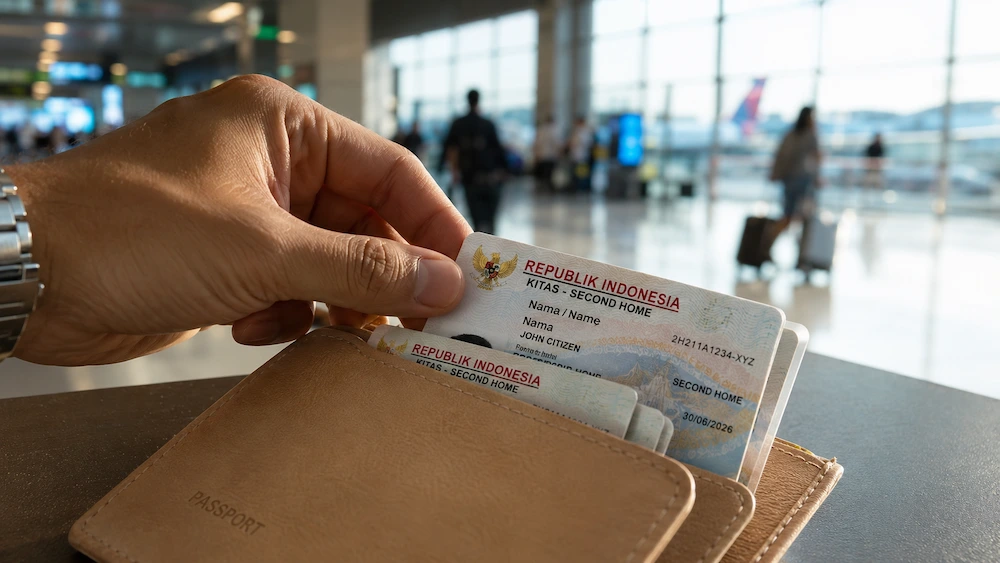
Second Home Visa Indonesia is widely regarded as the country’s most significant immigration reform in recent decades. Launched in 2022 under Government Regulation No. 48 of 2021 (GR 48/21), it gives high-net-worth foreigners a genuine path to multi-year residency, without needing a local employer or a business entity in Indonesia.
The visa comes in two tiers: a 5-year option and a 10-year option. Both permit multi-entry travel and grant family sponsorship rights. This guide breaks down every eligibility criterion, document requirement, cost, and step of the process.
What Is the Indonesia Second Home Visa?
The Second Home Visa is an official long-term residency visa, not a work permit. It is classified under two codes: B512 (5-year) Dan B513 (10-year). According to Indonesia’s Directorate General of Immigration (imigrasi.go.id), the visa was specifically created to attract wealthy foreign nationals, diaspora, and global investors looking for extended stays.
It does not grant work rights for Indonesian employers. However, it allows holders to invest in Indonesian businesses passively, open local bank accounts, obtain a driver’s license, and lease property. Remote work for a foreign employer sits in a grey area, widely practiced but not officially authorized.
Who Is This Visa Designed For?
- High-net-worth individuals seeking Indonesia long stay visa options
- Digital nomads and remote workers based outside Indonesia
- Wealthy retirees under 55 who do not qualify for a Retirement KITAS
- Foreign investors with passive interest in Indonesian businesses
- Indonesian diaspora seeking to reconnect with long-term residency
Indonesia Second Home Visa Requirements 2026
Itu Indonesia second home visa requirements 2026 are set by the Ministry of Law and Human Rights. The financial threshold is the most significant qualifier: applicants must demonstrate IDR 2,000,000,000 (approximately USD 126,000) held in an Indonesian state bank.
Alternatively, applicants may present proof of owning luxury property in Indonesia valued at a minimum of IDR 5,000,000,000. For the 5-year tier (B512), some interpretations suggest a lower deposit threshold of IDR 1 billion may apply. Official verification with the Directorate General of Immigration is strongly recommended before proceeding.
Key Eligibility Points
- No minimum age: Unlike the Retirement KITAS, there is no age floor.
- Valid passport: Must have at least 36 months of remaining validity.
- Clean immigration record: No prior deportation or immigration violations in Indonesia.
- Financial proof: IDR 2B deposit in a state bank (BNI, BRI, Mandiri, or BTN) OR IDR 5B in Indonesian property.
- Commitment statement: A signed declaration of intent to comply with Indonesian law.
Tips Profesional: The IDR 2 billion is NOT a fee. It stays in the applicant’s account and continues to earn interest. It simply needs to be held in an Indonesian state bank during the visa’s validity period.
Documents Required for the Second Home Visa Indonesia
Preparing the right documents is crucial to a smooth application. All foreign-language documents must be translated into Indonesian by a sworn translator (penerjemah tersumpah) accredited by the Indonesian Supreme Court.
Core Document Checklist
- Passport: Valid for at least 36 months from the intended date of entry.
- Proof of funds: Bank statement from an Indonesian state bank showing IDR 2B, or certified property ownership documents.
- Passport photos: Recent color photos, 4×6 cm, white background.
- Completed visa application form: Filed through evisa.imigrasi.go.id.
- Guarantor letter (Surat Jaminan): From an individual, company, or licensed immigration agent acting as penjamin.
- Health insurance certificate: Must be valid in Indonesia for the full visa period.
- Police clearance certificate: From the country of origin, apostilled or legalized at the Indonesian Embassy.
- Family documents (if applicable): Marriage certificate and birth certificates for any dependents, fully translated and legalized.
Tips Profesional: Apostille documents from Hague Convention countries are accepted directly. For non-convention countries, documents must be legalized at the nearest Indonesian Embassy.
How to Apply for the Second Home Visa Indonesia: Step by Step
The application process follows a clear sequence. While it is possible to self-apply, many applicants choose to engage an accredited immigration consultant to navigate the bureaucratic steps smoothly.
- Step 1: Open a savings or deposit account at a state bank in Indonesia (BNI, BRI, Mandiri, or BTN). This can often be done remotely through embassy banking representatives.
- Step 2: Transfer a minimum of IDR 2 billion into that account. Funds are not forfeited; they remain accessible as savings.
- Step 3: Prepare and legalize all required documents, including apostille, sworn translations, and police clearance.
- Step 4: Submit the online application through evisa.imigrasi.go.id. Upload all documents and pay the government visa fee.
- Step 5: Receive the e-VITAS (Electronic Limited Stay Visa), which is the entry clearance document.
- Step 6: Enter Indonesia within the e-VITAS validity window.
- Step 7: Report to the nearest Immigration office (Kantor Imigrasi) for biometric registration (fingerprints and photograph).
- Step 8: Receive the e-ITAS or second home KITAS Indonesia card, which functions as the physical residency permit.
- Step 9: Complete SKTT (residential address registration) at the local civil registration office (Dukcapil) within 14 days of receiving the KITAS.
Typical timeline: 4 to 8 weeks from document preparation to KITAS issuance, depending on the immigration office’s workload.
Tips Profesional: The SKTT registration (Surat Keterangan Tempat Tinggal) is mandatory, not optional. Missing the 14-day window after KITAS issuance can result in penalties. Schedule it immediately upon receiving the KITAS.
Indonesia Second Home Visa Cost: What to Expect in 2026
Itu Indonesia second home visa cost primarily comes down to two items: the refundable bank deposit and document legalization expenses. Below is a transparent breakdown of the main financial commitments applicants should prepare for.
| Cost Item | 5-Year Visa (B512) | 10-Year Visa (B513) |
| Bank Deposit (refundable) | IDR 2,000,000,000 | IDR 2,000,000,000 |
| Document Legalization (apostille, sworn translation) | USD 150-400 | USD 150-400 |
Penting: The IDR 2 billion deposit earns interest at the prevailing bank rate and can be withdrawn when the visa expires or is not renewed. It is a financial guarantee, not a government payment.
For the property route (IDR 5B minimum), applicants should also account for property due diligence and notary costs, which vary based on the property’s location and complexity. Consulting a licensed notary (PPAT) in Indonesia is recommended to get an accurate estimate.
Can You Bring Your Family?
Yes. The second home visa Indonesia IDR 2 billion deposit by the primary holder covers the family sponsorship. A spouse, children, and even parents of the primary holder can apply for a Second Home Family KITAS (KITAS Keluarga).
Each dependent follows a similar document requirement and must apply individually. All family KITAS holders share the same validity period as the primary holder. Applications can be submitted simultaneously to avoid delays.
Key Points for Family Sponsorship
- Dependent KITAS is issued for the same duration as the primary holder’s KITAS
- Each dependent must provide their own health insurance valid in Indonesia
- Marriage and birth certificates must be apostilled and sworn-translated into Indonesian
- Parents of the primary holder are eligible (not all visa categories allow parental sponsorship)
Baca juga: Indonesia Retirement Visa: The Complete 2026 Guide for Foreign Retirees
What Can (and Cannot) You Do on a Second Home Visa?
Understanding the scope of permitted activities is essential before committing to this visa. The regulations are clear on what is allowed, and where grey areas exist.
Permitted Activities
- Long-term residency in Indonesia for the full visa duration
- Leasing property and signing long-term rental agreements
- Opening a personal bank account at local and international banks
- Obtaining an Indonesian driver’s license (SIM)
- Passive investment in Indonesian businesses (shareholder, not active management)
- Remote work for a foreign-based employer (widely practiced; not officially codified)
Not Permitted
- Working for or receiving income from an Indonesian employer
- Actively managing or operating an Indonesian business
- Earning income from Indonesian sources without proper licensing
- Converting this visa directly to a work permit (KITAS Kerja)
Tips Profesional: Many remote workers and digital nomads use the Second Home Visa for Indonesia long stay purposes while working for foreign companies. While not officially regulated, immigration enforcement has historically been tolerant of this practice.
Second Home Visa vs. Retirement KITAS vs. Investor KITAS
Choosing the right visa requires understanding the differences across Indonesia’s key long-stay residency options. The table below provides a direct comparison to help prospective applicants identify the best fit.
| Fitur | Second Home Visa | KITAS Pensiun | Investor KITAS |
| Min. Age | None | 55 years | None |
| Financial Req. | IDR 2B deposit / IDR 5B property | Proof of pension/income | Min. IDR 10B investment |
| Keabsahan | 5 or 10 years | 1 year (renewable) | 2 years (renewable) |
| Work Rights | No (remote work tolerated) | TIDAK | Limited (own entity) |
| Family Rights | Yes (spouse, children, parents) | Yes (spouse only) | Ya |
| Path to KITAP | Yes (after 3 years) | Yes (after 3 years) | Yes (after 3 years) |
| Renewal Process | Simpler, online-friendly | Annual, more complex | Tied to business status |
Decision Guide: Which Visa Fits Your Profile?
- Under 55 with liquid capital: Second Home Visa is the strongest choice. No age barrier and flexible use of funds.
- Over 55 with pension income: The Retirement KITAS may be more cost-effective. No large deposit required.
- Active business plans in Indonesia: Consider the Investor KITAS, which is tied to business entity registration.
- Family relocation with multiple dependents: Second Home Visa offers the broadest family inclusion, including parents.
Path to Permanent Residency (KITAP) and Beyond
The Second Home Visa is not just a temporary stay option. It can be a stepping stone to permanent residency in Indonesia. After holding any valid KITAS category for three consecutive years, a foreigner becomes eligible to apply for KITAP (Kartu Izin Tinggal Tetap), Indonesia’s permanent stay permit.
KITAP is valid for 5 years and auto-renewable. KITAP holders are also eligible to obtain an Indonesian ID card (KTP), which grants them access to most services available to Indonesian citizens.
The Residency Pathway
- Year 1-3: Hold Second Home KITAS, maintain deposit in state bank.
- Year 3+: Apply for KITAP (permanent stay permit), valid for 5 years.
- Year 5+ on KITAP: Eligible to apply for Indonesian naturalization (citizenship), subject to meeting additional criteria.
- KTP Eligibility: KITAP holders can apply for an Indonesian identification card.
Tips Profesional: Maintaining a clean residency record throughout the KITAS period is essential for a successful KITAP application. Any overstay, even by a few days, can jeopardize the path to permanent residency.
Summary: Is the Second Home Visa Indonesia Right for You?
Itu second home visa Indonesia is one of the most flexible and attractive long-term residency options available in Southeast Asia. With no age restriction, a refundable deposit structure, and genuine 5 or 10-year validity, it competes strongly with similar programmes in Thailand, Malaysia, and the UAE.
For high-net-worth individuals, retirees under 55, global remote workers, and diaspora looking to reconnect with Indonesia, this visa delivers genuine stability, family inclusion, and a credible path to permanent residency.
Key Takeaways
- Two tiers available: 5-year (B512) and 10-year (B513) with multi-entry
- Financial requirement: IDR 2B in an Indonesian state bank or IDR 5B in property
- Deposit is refundable and interest-bearing, not a fee
- Family members including parents are eligible for dependent KITAS
- Opens a pathway to KITAP (permanent residency) after 3 years
- No minimum age, making it accessible to younger HNWIs not eligible for Retirement KITAS

Artikel Oleh
Tjhia Edy Tarlesno, SH, LLM.
Edy adalah COO Business Hub Asia dengan pengalaman lebih dari 20 tahun di bidang hukum, kepatuhan, dan investasi asing, memimpin operasional dan strategi regulasi di seluruh Indonesia dan Asia Tenggara.
Tetap update dengan wawasan pasar
Pertanyaan yang Sering Diajukan
What is the minimum financial requirement for the Second Home Visa Indonesia?
Applicants must maintain a minimum of IDR 2,000,000,000 (approximately USD 126,000 as of 2026) in a designated Indonesian state bank. Alternatively, they may present proof of owning property in Indonesia valued at a minimum of IDR 5,000,000,000.
Is the IDR 2 billion deposit a fee or a guarantee?
It is a financial guarantee, not a fee. The funds remain in the applicant’s personal bank account and continue to earn interest at the bank’s savings rate. The deposit must be maintained throughout the visa’s validity period.
Can the Second Home Visa holder work in Indonesia?
The visa does not grant work rights for Indonesian employers or local income-generating activities. Remote work for a foreign employer is widely practiced by holders, but it is not formally regulated under this visa category.
How long does it take to get the Second Home Visa approved?
From document preparation to KITAS issuance, the process typically takes 4 to 8 weeks. Processing timelines can vary depending on the immigration office and the completeness of the submitted documents.
Can family members be included in the Second Home Visa application?
Yes. The primary holder can sponsor a spouse, children, and parents under the Second Home Family KITAS. Each dependent must submit their own documentation. All family KITAS holders receive the same validity as the primary holder.
What is a second home KITAS Indonesia?
Once an applicant enters Indonesia on a Second Home e-VITAS and completes biometric registration at the immigration office, they receive the e-ITAS or KITAS card. This physical card serves as their official residency permit for the duration of the visa.
Is there a minimum age requirement for the Second Home Visa?
No. Unlike the Retirement KITAS, which requires applicants to be at least 55 years old, the Second Home Visa has no minimum or maximum age restriction. This makes it accessible to younger HNWIs and working-age individuals.
Can a Second Home Visa holder apply for permanent residency (KITAP)?
Yes. After holding a valid KITAS for three consecutive years, including the Second Home KITAS, a foreigner becomes eligible to apply for KITAP. KITAP is valid for 5 years and auto-renewable.
What happens to the bank deposit if the visa is not renewed?
The deposit is the applicant’s own money and can be withdrawn once the visa expires or if the applicant chooses not to renew. The bank account itself does not need to be closed; the funds simply no longer need to meet the IDR 2 billion threshold.
Is it possible to apply for the Second Home Visa without visiting Indonesia first?
Yes, to a degree. Document preparation and bank account opening can often be initiated remotely through embassy representatives or licensed agents. However, biometric registration and SKTT confirmation must be completed in person in Indonesia after entry.
Hubungi Tim Kami
Beri tahu kami bagaimana kami dapat membantu pembentukan atau perluasan perusahaan Anda.
Mulailah Memasuki Pasar Asia Tenggara dengan Percaya Diri
Business Hub Asia siap membantu Anda memahami regulasi di Indonesia, Vietnam, dan Filipina, mulai dari perizinan usaha dan pendaftaran produk hingga manajemen tenaga kerja. Dengan pendekatan yang efisien, akurat, dan berfokus pada bisnis.
Penafian
Konten yang disediakan di situs web ini diterbitkan oleh PT. Bisnis Hub Asia (“Kami", atau "kita") hanya untuk tujuan informasi umum. Meskipun segala upaya telah dilakukan untuk memastikan keakuratan dan ketepatan waktu informasi yang disajikan, kami tidak memberikan pernyataan atau jaminan, baik tersurat maupun tersirat, mengenai kelengkapan, keakuratan, keandalan, kesesuaian, atau ketersediaan konten, produk, atau layanan apa pun yang dijelaskan di situs web ini. Segala ketergantungan pada informasi tersebut sepenuhnya merupakan risiko pengguna sendiri.
Kami adalah badan swasta dan independen dan adalah tidak berafiliasi dengan, diizinkan oleh, atau bertindak atas nama Pemerintah Republik Indonesia, kementerian, lembaga, atau perwakilan resmi yang ditunjuk. Situs web ini tidak bukan menyediakan, menawarkan, atau mempromosikan dokumen atau layanan resmi pemerintah, termasuk namun tidak terbatas pada:
Nomor Induk Berusaha (NIB);
Pengembalian atau potongan pajak;
Izin Tinggal atau otorisasi perjalanan elektronik;
Paspor atau dokumen terkait imigrasi lainnya.
Referensi apa pun terhadap layanan tersebut diberikan semata-mata untuk tujuan informasi umum dan tidak boleh ditafsirkan sebagai tawaran atau fasilitasi layanan resmi.
Kami berkomitmen untuk memastikan perlindungan data pribadi Anda sesuai dengan Undang-Undang Nomor 27 Tahun 2022 tentang Perlindungan Data PribadiSegala informasi pribadi yang dikumpulkan melalui situs web ini akan diproses untuk tujuan yang dijelaskan secara jelas dalam [Pernyataan Privasi] kami. Kami tidak menjual atau menyalahgunakan data pribadi dalam keadaan apa pun.
Dengan mengakses dan menggunakan situs web ini, Anda mengakui dan menyetujui ketentuan yang tercantum dalam Pernyataan Penyangkalan ini. Anda selanjutnya setuju untuk menggunakan situs web ini dan informasi yang diberikan secara bertanggung jawab dan sesuai dengan hukum dan peraturan yang berlaku.
Untuk informasi lebih lanjut atau pertanyaan mengenai Sanggahan ini, silakan hubungi kami melalui saluran yang disediakan di halaman Kontak kami.
Anda Mungkin Juga Menyukai
Tetap terinformasi dengan wawasan, panduan, dan artikel terbaru kami tentang menjalankan bisnis di Asia Tenggara.
Imigrasi
Mixed Marriage in Indonesia: How to Report Your Marriage the Right Way

Fahri Ramanda Putra • September 3, 2026
Imigrasi
Visa on Arrival Indonesia: Converting to a Stay Permit Without Leaving
Fahri Ramanda Putra • September 2, 2026
Imigrasi
Spouse KITAS Indonesia: Applying From Abroad While Your Marriage Is Registered Overseas
Fahri Ramanda Putra • September 1, 2026