









How to Open a Padel Court in Indonesia: A 2026 Step-by-Step Guide for Foreign Investors
April 24, 2026
•
9 minutes read
Content
Indonesia’s padel industry is growing at 74% annually, and for foreign investors looking to enter the sports and lifestyle sector, the timing has rarely looked better. Understanding how to open a padel court in Indonesia is the critical first step, and the process is more streamlined than many expect.
This guide covers every practical step, from choosing the right legal structure and navigating Indonesia’s 2026 licensing system, to selecting your location and building a venue that is built to last. Whether the plan is a single boutique court in Bali or a multi-court complex in Jakarta, the regulatory pathway is the same.
Step 1: Choose the Right Legal Entity
Foreign nationals cannot operate a business in Indonesia under their personal name. The correct legal vehicle for any foreign-owned sports business in the country is the PT PMA (Perseroan Terbatas P
enanaman Modal Asing), or Foreign-Owned Limited Liability Company.
A PT PMA can be either partially or fully foreign-owned. It is the standard structure used by thousands of foreign investors across industries in Indonesia, including hospitality, retail, and sports. As of 2024, the PT PMA can be established in approximately four to six weeks, down from several months in previous years. (Source: U.S. Commercial Service Indonesia)
PT PMA key requirements (2026):
– Minimum two shareholders (can be individuals or legal entities)
– At least one foreign shareholder
– A President Director who resides in Indonesia
– Foreign directors must obtain a KITAS (work and stay permit)
– Minimum investment value of IDR 10 billion per business activity code (KBLI) per project, per GR 28/2025
– Paid-up capital structure must align with your investment plan and OSS filing
(Source: LMI Consultancy)
Step 2: Select the Correct KBLI Code
Indonesia uses a national business classification system called KBLI (Klasifikasi Baku Lapangan Usaha Indonesia) to categorize every type of business activity. Selecting the correct KBLI code is not just administrative. It determines which licenses are required, how much regulatory oversight applies, and whether your business is open to full foreign ownership.
In 2026, Indonesia transitioned to KBLI 2025 under Regulation No. 7 of 2025, which formally replaced the previous KBLI 2020 framework. All new PT PMA companies incorporated in 2026 must use KBLI 2025 from day one. Existing companies have until mid-2026 to update their codes.
For padel courts, the appropriate classification falls under KBLI 93114, which covers sports facilities similar to racket sports venues. Padel is not explicitly named in the regulation, but its characteristics align closely enough with this category for it to be the standard classification used in practice. (Source: SSEK Law Firm)
What KBLI 93114 means for your padel business:
– Classified as a low-risk business activity
– NIB (Business Identification Number) generally serves as both your operational and commercial license
– No Standard Certificate (Sertifikat Standar) required in most cases
– Simpler licensing process compared to medium- or high-risk sectors
Pro Tip: Always verify your KBLI selection with a certified legal consultant before submitting your OSS application. Choosing the wrong code under KBLI 2025 can result in licensing delays, rejected permits, or capital compliance issues that are costly to unwind. (Source: APAC News)
Step 3: Register Through the OSS System
Indonesia’s Online Single Submission (OSS) portal is the central platform where all company registrations, NIB applications, and business licenses are processed. It is run by the Ministry of Investment (BKPM) and is the mandatory entry point for every PT PMA.
The OSS system operates on a risk-based approach, meaning the licenses your business needs are determined by the risk level of your declared KBLI activity. For padel courts under KBLI 93114 (low risk), the NIB functions as the core operating license. Access the official portal at https://oss.go.id/
Documents typically required for OSS registration:
– Notarized deed of establishment (Articles of Association)
– Shareholder passport copies (minimum 18 months validity)
– Director and commissioner details
– Declared investment plan consistent with your KBLI
– Domicile statement or office address documentation
Under Government Regulation No. 28 of 2025 (GR 28/2025), which took effect in 2025 and is fully enforced in 2026, OSS now requires stricter data consistency. Every element of your filing, from company purpose to capital structure and KBLI selection, must align exactly across all submitted documents.
Step 4: Secure Your Business Identification Number (NIB)
The NIB (Nomor Induk Berusaha) is your company’s unified business registration number. It serves simultaneously as proof of company registration, your import license number, and your customs identification. For low-risk activities like padel courts, it is effectively your operating license.
The NIB is issued automatically through the OSS portal after your PT PMA documents are submitted and verified. Its simplicity is one of the benefits of operating under a low-risk KBLI classification. (Source: U.S. Commercial Service)
Alongside the NIB, the company must obtain a Tax Identification Number (NPWP) from the Directorate General of Taxes. The NPWP is mandatory for all financial transactions, tax reporting, and any future permit applications.
Step 5: Obtain Building and Construction Permits
Beyond company registration, opening a padel court in Indonesia requires building-specific approvals. These permits are issued at the local district (kabupaten/kota) level, which is important to understand before selecting a location.
Core building permits required:
– PBG (Persetujuan Bangunan Gedung): Building Approval, which replaced the old IMB. Required to confirm the structure complies with spatial planning and technical building standards.
– SLF (Sertifikat Laik Fungsi): Building Function Certificate, issued after construction is completed and inspected. Required before commercial operations begin.
– Zoning clearance: Confirming that the chosen location is designated for commercial or sports use under the local spatial plan (RDTR).
Important: Indonesia is a decentralized country. Permits are issued at the district level, and zoning rules vary significantly between Jakarta, Banten, Bali, Bandung, and other regions. Confirming zoning before signing any lease or land purchase is essential.
A note on residential zoning: In early 2026, several padel venues in East and South Jakarta faced community lawsuits and court rulings ordering permit revocations after being built in residential zones. This risk is entirely avoidable by selecting a clearly commercial or mixed-use location. (Source: The Star)
Step 6: Navigate the LKPM Reporting Obligation
Foreign-owned companies operating in Indonesia are required to submit regular investment activity reports through the LKPM (Laporan Kegiatan Penanaman Modal) system. These reports track how the company’s capital is being deployed relative to its declared investment plan.
Under GR 28/2025, LKPM reporting is more strictly monitored. Companies with mismatched capital activity, outdated NIB data, or unreported business changes face potential license suspension.
LKPM reports are submitted quarterly for companies in the investment realization phase, and semi-annually after the business reaches full operations. This is a routine compliance task and easily managed with local accounting or legal support.
Step 7: Build the Court to Indonesian Standards
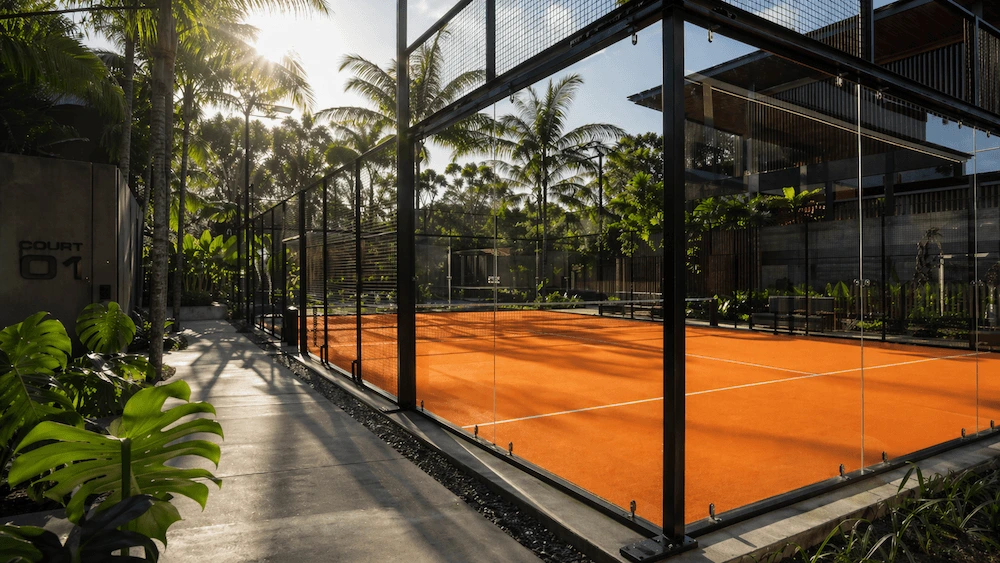
Once permits are secured, construction planning begins. The technical standards for padel courts in Indonesia largely follow International Padel Federation (FIP) specifications, which most reputable local contractors work to.
Standard padel court dimensions and specs:
– Court size: 20 meters long x 10 meters wide
– Enclosed by glass walls (3 to 4 meters high) and metal mesh
– Surface: synthetic artificial grass (typically 10 to 12mm pile)
– Lighting: minimum 300 to 500 lux for recreational; 800 to 1,000 lux for competition
Construction cost reference (per court, 2026):
– Structure and steel frame: IDR 250 million to IDR 400 million
– Court surface (synthetic grass): IDR 100 million to IDR 200 million
– Glass panels, fencing, and lighting: IDR 100 million to IDR 150 million
– Booking system and operations setup: IDR 20 million to IDR 50 million
– Total per court: IDR 600 million to IDR 1.6 billion
Pro Tip: Work with contractors who have prior padel court experience and can provide case references. Courts built with sub-standard turf or inadequate drainage become costly to repair and damage the customer experience early on.
Step 8: Set Up Operations Before Opening Day
Technical construction is only part of the opening checklist. A padel venue needs a complete operational infrastructure before welcoming its first players.
Operational checklist before launch:
– Digital court booking system (AYO and Courtside are the dominant platforms in Indonesia)
– Payment integration with QRIS and e-wallets (preferred by 42% of Gen Z and 43% of Millennials in Indonesia, per Populix 2025)
– Staffing: court supervisor, receptionist, and at least one certified coach
– House rules, safety signage, and court maintenance schedule
– Social media presence and community-building plan
The digital booking and payment experience is not optional in Indonesia’s padel market. Players expect to book instantly, pay seamlessly, and receive digital confirmations. Venues that lag in this area lose bookings to competitors who do not.
Realistic Timeline: From Decision to Opening Day
For a foreign investor setting up a PT PMA and building a multi-court venue, the following is a realistic end-to-end timeline:
| Phase | Duration |
|---|---|
| Legal consultation and PT PMA incorporation | 4 to 6 weeks |
| NIB and NPWP registration via OSS | 1 to 2 weeks |
| Site identification, lease or land purchase | 2 to 6 weeks |
| Zoning verification and PBG application | 4 to 8 weeks |
| Construction (4-court venue) | 10 to 16 weeks |
| SLF inspection and approval | 2 to 4 weeks |
| Operational setup and soft launch | 2 to 4 weeks |
| Total estimated timeline | 6 to 12 months |
The most variable factor is the building permit timeline, which depends heavily on the local district government and whether the site is in a clearly commercial zone.
Common Mistakes Foreign Investors Make
Learning from the missteps of others is one of the most efficient things any investor can do. Here are the recurring errors seen in Indonesia’s padel market:
- Wrong KBLI code at incorporation: Choosing a mismatched business classification delays licensing and can require costly restructuring of corporate documents.
- Skipping zoning verification: Building in a residential zone without proper clearance is the single biggest legal risk in the current market.
- Underestimating operational requirements: Courts without booking apps, experienced staff, and a community program consistently underperform against well-managed competitors.
- Ignoring KBLI 2025 transition: Existing businesses that have not updated their KBLI codes to the 2025 system by mid-2026 risk having their NIB flagged or blocked in the OSS system.
- Building in an already-saturated micro-market: South Jakarta now has significant competition. Banten, Bandung, and secondary cities offer better entry conditions.
Read also: Padel Court Business in Indonesia: ROI, Costs, and Market Opportunity in 2026.
Summary: What It Takes to Open a Padel Court in Indonesia
Opening a padel court in Indonesia as a foreign investor is a well-defined process with clear regulatory steps and strong commercial fundamentals supporting it. The licensing pathway is accessible, the demand is proven, and the operational model is replicable across cities.
The key ingredients are the right legal structure (PT PMA), the correct KBLI classification (93114), a commercially zoned location, and an operationally strong venue. Getting these four elements right puts any investor in a strong position to participate in what is, by every metric, one of the most compelling sports investment markets in Southeast Asia right now.
Frequently Asked Questions
Can a foreigner fully own a padel court business in Indonesia?
Yes. Through a PT PMA structure, a foreign investor can hold 100% or partial ownership of a padel venue in Indonesia. The sports facility sector under KBLI 93114 is open to foreign investment under Indonesia’s current Positive Investment List.
What licenses are required to open a padel court in Indonesia?
At minimum, a NIB (Business Identification Number) from the OSS system and a PBG (Building Approval). An SLF (Building Function Certificate) is required before commencing operations. Depending on the location, additional zoning clearance may also be needed.
What is KBLI 93114 and why does it matter for padel businesses?
KBLI 93114 is the Indonesian business classification code for racket sport facilities, and it is the standard classification used for padel courts. It determines that the business is low-risk, which simplifies the licensing process and means the NIB functions as the primary operating license.
What is the minimum capital requirement for a PT PMA in Indonesia?
Under Government Regulation No. 28 of 2025, the minimum investment value per business activity (KBLI) is IDR 10 billion per project. This covers machinery, equipment, working capital, and project costs, not just equity capital.
How long does it take to set up a PT PMA in Indonesia?
The PT PMA incorporation process itself typically takes four to six weeks as of 2024, following reforms under the Omnibus Law. The full process from incorporation to court opening takes six to twelve months depending on construction and permit timelines.
What is the OSS system in Indonesia and how does it work?
OSS (Online Single Submission) at https://oss.go.id/ is Indonesia’s centralized digital platform for company registration, NIB issuance, and business licensing. It operates on a risk-based approach, meaning your licensing requirements are linked to the risk level of your declared business activity (KBLI code).
Do padel venues in Indonesia need to operate their own booking app?
Not necessarily their own app, but integrating with existing platforms is strongly recommended. AYO and Courtside are the dominant court booking apps in Indonesia. Players expect instant digital booking and QRIS or e-wallet payment options.
Is Bali or Jakarta better for opening a padel court?
Both markets are commercially strong but serve different audiences. Jakarta offers higher volume and corporate demand. Bali commands premium pricing from tourists and expats. Investors new to the Indonesian market may find Bali’s more international business environment easier to navigate initially.
What zoning mistakes should foreign investors avoid?
Avoid building in residential zones entirely. Early 2026 saw multiple Jakarta venues face legal challenges from residents and court orders revoking their building permits. Always verify that the chosen site is designated for commercial or mixed-use activity under the local spatial plan before proceeding.
What Indonesian regulations govern padel businesses in 2026?
Key regulations include: Government Regulation No. 28 of 2025 (GR 28/2025) governing OSS and PT PMA licensing, KBLI Regulation No. 7 of 2025 (KBLI 2025) governing business classifications, Presidential Regulation No. 10 of 2021 (amended by No. 49 of 2021) on the Positive Investment List, and building regulations under the PBG/SLF framework introduced by Law No. 11 of 2020 on Job Creation.
Get in Touch With Our Team
Let us know how we can assist with your company formation or expansion.
Start Your SEA Market Entry with Confidence
Business Hub Asia is ready to help you navigate Indonesia, Vietnam, and Philippines regulations, from business licensing and product registration to workforce management. With an efficient, accurate, and business-focused approach.
Disclaimer
The content provided on this website is published by PT. Bisnis Hub Asia (“we“, or “us“) for general informational purposes only. While every effort is made to ensure the accuracy and timeliness of the information presented, we make no representations or warranties, express or implied, as to the completeness, accuracy, reliability, suitability, or availability of any content, products, or services described on this website. Any reliance placed on such information is strictly at the user’s own risk.
We are a private, independent entity and are not affiliated with, authorized by, or acting on behalf of the Government of the Republic of Indonesia, its ministries, agencies, or any officially appointed representatives. This website does not provide, offer, or promote any official government documents or services, including but not limited to:
-
Business identification numbers (Nomor Induk Berusaha – NIB);
-
Tax refunds or rebates;
-
Stay Permit or electronic travel authorizations;
-
Passports or other immigration-related documents.
Any references to such services are provided solely for general informational purposes and should not be construed as an offer or facilitation of official services.
We are committed to ensuring the protection of your personal data in accordance with Law No. 27 of 2022 on Personal Data Protection. Any personal information collected through this website will be processed for the purposes clearly stated in our [Privacy Statement]. We do not sell or misuse personal data under any circumstances.
By accessing and using this website, you acknowledge and agree to the terms set out in this Disclaimer. You further agree to use this website and the information provided responsibly and in compliance with applicable laws and regulations.
For further information or questions regarding this Disclaimer, please contact us via the channels provided on our Contact page.
You May Also Like
Stay informed with our latest insights, guides, and articles on doing business in Southeast Asia.
Business License
How to Navigate KBLI 2025 Adjustments Before the June 2026 Deadline

Tjhia Edy Tarlesno, SH, LLM. • April 24, 2026
Business License
Padel Court Business in Indonesia: ROI, Costs, and Market Opportunity in 2026 (Noteworthy)

Ing. Michal Wasserbauer, Ph.D., CPA (Australia) • April 23, 2026
Business License
Green Special Economic Zones in Indonesia: The Sustainable Industrial Frontier of 2026
Tjhia Edy Tarlesno, SH, LLM. • April 22, 2026