




Padel Court Business in Indonesia: ROI, Costs, and Market Opportunity in 2026 (Noteworthy)
April 23, 2026
•
8 minutes read

Content
Indonesia has quietly become one of the most exciting sports investment stories in Southeast Asia. The padel court business Indonesia is no longer a niche conversation among sports insiders. It is now a mainstream investment category attracting capital from both domestic and foreign investors.
The numbers are hard to ignore. According to the Indonesia Padel Report 2025 by Core & Court and Growell, Indonesia recorded a 295% increase in padel clubs and saw over 1,580 new courts built in 2025 alone. The country’s annual court growth rate stands at 74%, making it the fastest-growing padel market in Southeast Asia. (Source: Indonesia Padel Report 2025)
Why Indonesia Is the Padel Market No Investor Should Ignore
The global padel market crossed 70,000 courts worldwide in early 2026, according to the International Padel Federation (FIP). Indonesia is one of the top-flagged high-growth markets in every major global padel report. (Source: FIP Global Report)
What separates Indonesia from other emerging padel markets is the size of the unmet demand. Even with over 700 clubs expected to be operational by 2026, court slots remain overbooked in Jakarta and Bali. That supply-demand gap is where the opportunity lives.
Key reasons Indonesia stands out for padel investment:
– Fastest GMV growth globally per court, rising from €2,300 to €6,300 per month between 2023 and 2024
– A young urban population of over 20,000 active padel players, growing rapidly
– Strong organic community adoption across Jakarta, Banten, Bali, and Bandung
– Indonesia’s padel ecosystem is positioned as the largest in Southeast Asia, surpassing Malaysia, Thailand, and the Philippines
The Real Revenue Numbers Behind a Padel Court Business Indonesia
Before committing capital, investors naturally want to see what returns look like in practice. The revenue model for a padel venue in Indonesia is straightforward, and the margins are compelling.
Court rental rates in Jakarta average between IDR 400,000 and IDR 600,000 per hour. Premium venues in South Jakarta and Bali charge up to IDR 850,000 per hour. With courts typically operating 10 to 12 hours per day, a single court can generate IDR 60 million to IDR 90 million in monthly gross revenue. (Source: The Jakarta Post)
Revenue streams for a padel venue in Indonesia:
– Court hourly rental (primary revenue driver)
– Monthly memberships and community packages
– Coaching and training programs
– Food and beverage (F&B) service
– Corporate wellness and team-building bookings
– Sponsorships and branded tournament events
Pro Tip: Venues that build an F&B offering alongside courts significantly increase revenue per visit. Average per-visit spending, including F&B, reaches IDR 450,000, according to a Liga.Tennis racquet sports report covering 8 clubs across 2025. (Source: The Southeast Asia Desk)
Occupancy Rates: What Operators Are Actually Seeing
Occupancy is the metric that matters most for early-stage padel businesses in Indonesia, and the figures reported by operators are exceptional for any hospitality or sports investment.
WePadl in Pondok Indah, South Jakarta, reported a minimum occupancy rate of 87% since opening in early 2025. In one South Jakarta venue operating 18 hours per day, occupancy briefly hit 99%.
The average across Jakarta venues sits consistently above 70%, well above the threshold needed to achieve profitability. (Source: The Jakarta Post)
These are not cherry-picked outliers. According to a 2025 racquet sports market analysis covering multiple cities, the average occupancy rate for padel across Indonesia reaches 70%, which already exceeds operating break-even for most venue formats. (Source: The Southeast Asia Desk)
How Much Does It Cost to Open a Padel Court in Indonesia?
Cost clarity is essential for any investor evaluating a padel court business in Indonesia. The investment range is wide depending on location, format, and scale, but the numbers are well-documented.
Estimated cost per single padel court:
– Main structure and steel frame: IDR 250 million to IDR 400 million
– Court surface and synthetic grass: IDR 100 million to IDR 200 million
– Lighting, glass panels, and fencing: IDR 100 million to IDR 150 million
– Online booking system and operational setup: IDR 20 million to IDR 50 million
– Total per court: IDR 600 million to IDR 1.6 billion
(Source: The Star)
For a four-court venue, total development investment typically falls in the IDR 4.2 billion to IDR 6 billion range (approximately USD 260,000 to USD 375,000). At moderate occupancy rates, this investment can realistically pay back within two to three years.
Pro Tip: Banten province, which borders Greater Jakarta, offers land and infrastructure costs 15 to 20% lower than Jakarta itself. For investors looking to build a scalable multi-court venue, Banten is emerging as an attractive lower-cost alternative without sacrificing market access. (Source: Padelbiz.it)
Indoor vs. Outdoor: Choosing the Right Format
The choice between indoor and outdoor courts affects both cost and long-term revenue stability. Indonesia’s tropical climate makes this decision more complex than it would be in European markets.
Indoor courts:
– Higher upfront cost (climate control, enclosed structure)
– More consistent year-round bookings
– Better premium pricing potential
– Preferred in Bali due to tourism-driven demand and expat clientele
Outdoor courts:
– Lower build cost, faster to deploy
– Highly popular in residential neighborhoods of Jakarta and Tangerang
– Exposed to seasonal weather, especially the November to February rainy season
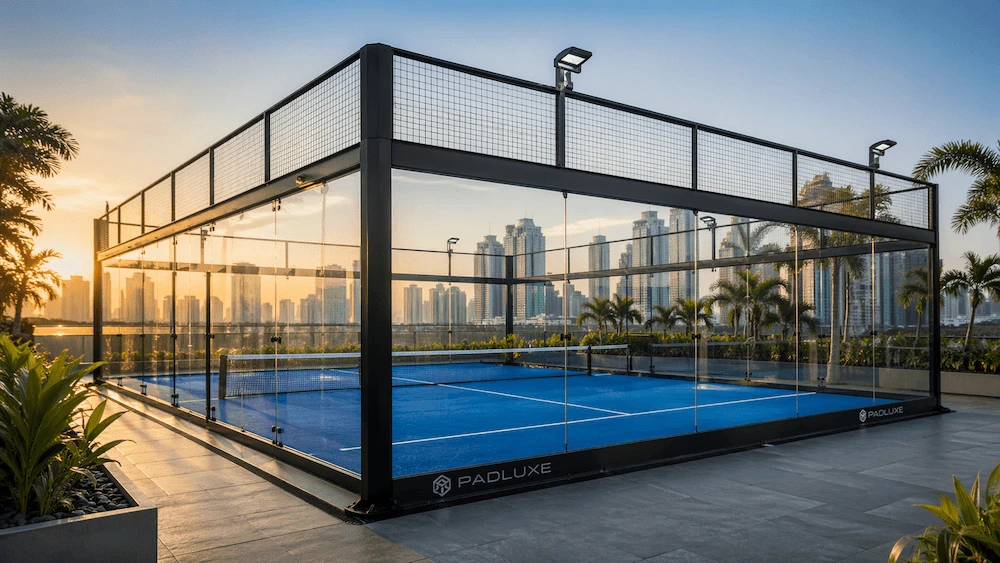
– Require weather-resistant synthetic turf and drainage planning
Many successful operators in Indonesia are adopting a hybrid model, combining covered and open structures to balance cost with weather resilience.
Where to Build: Jakarta, Bali, or Beyond?
Location strategy is one of the most critical decisions in a padel business. Each market in Indonesia has a distinct demand profile, pricing ceiling, and competition level.
Jakarta (and Banten): South Jakarta leads with the highest concentration of new clubs. Banten follows a high-growth satellite market with lower land costs. Jakarta’s demand is driven by corporate professionals, young urban residents, and community clubs.
Bali: Bali is a more mature market where quality now outweighs quantity. Premium and semi-premium courts average IDR 423,000 to IDR 431,000 per hour, with top-tier venues reaching IDR 850,000. Expats, international tourists, and Indonesia’s upper-income segment drive demand. (Source: Padelbiz.it)
Secondary Cities (Bandung, Surabaya, Makassar): Bandung saw a 4.8-fold increase in padel clubs in 2025. These markets carry lower competition, lower entry costs, and growing middle-class demand. They are ideal for investors seeking earlier-mover advantages outside the capital.
Is Padel in Indonesia Just a Trend?
This is the question every serious investor asks. The concern is valid, especially given that other sports crazes in Indonesia, from Muay Thai to cycling, have faded after initial excitement. The evidence, however, suggests padel has fundamentally different characteristics.
Padel has a 92% player return rate globally, meaning 9 out of 10 people who try it come back. That figure is exceptional for any sport, and it is the clearest indicator of long-term demand. (Source: Playtomic Global Padel Report 2025)
Beyond participation rates, padel in Indonesia has been adopted by corporate wellness programs, lifestyle communities, property developers (with courts built into new residential developments), and even university campuses. The structural integration of padel into urban life is deeper than any previous sports trend in the country.
Key Risks Investors Should Understand
No investment opportunity comes without risks, and the padel court business in Indonesia is no exception. Understanding these risks is what separates disciplined investors from speculative ones.
Main risks to assess:
- Zoning and residential conflict: In early 2026, courts built in residential areas near Jakarta faced community complaints and legal challenges over noise and permit issues. Choosing a clearly commercial or mixed-use zone avoids this risk entirely. (Source: The Star)
- Operational inexperience: Courts without proper management, coaching programs, and booking systems underperform significantly compared to well-run venues.
- Location saturation: South Jakarta is entering a more competitive phase. Investors entering now should look toward Banten, Bandung, or secondary cities for higher margin potential.
- The Sweden precedent: Sweden’s padel boom was followed by oversupply and a sharp correction. Indonesia’s demand-supply gap remains wide, but markets like South Jakarta require careful analysis before entering.
Pro Tip: The most resilient padel businesses in Indonesia are those that treat the venue as a lifestyle destination rather than a court-rental utility. Adding F&B, events, and coaching creates retention and diversifies revenue beyond hourly bookings.
The 3-Year ROI Case: A Simple Projection
For a four-court indoor venue in South Jakarta or central Bali, the numbers work as follows at conservative estimates:
- Total build cost: IDR 5 billion
- Average hourly rate: IDR 500,000
- Operating hours per day per court: 10 hours
- Occupancy rate (conservative): 65%
- Gross daily revenue (4 courts): IDR 13 million
- Monthly gross revenue: IDR 390 million
- Annual gross revenue: IDR 4.68 billion
Even after accounting for operating costs (staff, utilities, maintenance, marketing) at 40% of revenue, the annual net revenue comes to approximately IDR 2.8 billion.
At this rate, full payback on a IDR 5 billion investment occurs in under two years, with a strong ongoing margin thereafter.
These projections align with what operators on the ground are reporting. As one Jakarta venue co-founder noted publicly, four courts priced between IDR 400,000 and IDR 700,000 per hour could pay off construction costs “in just over a year” at 50% occupancy.
Summary: Why 2026 Is Still the Right Time to Enter
The padel court business in Indonesia is past the speculation phase and entering its commercial maturity.
The market is large, demand is proven, occupancy rates are exceptional, and the regulatory pathway for foreign investors is clearly defined.
The window for early-mover advantage still exists, particularly outside South Jakarta.
Investors who act in 2026 are entering a market where supply is still well below demand, consumer spending on padel is growing, and the sport has embedded itself deeply into Indonesian urban lifestyle.
Indonesia is not simply following global padel trends. It is now setting them.
If you are ready to capitalize on this momentum, discover how BusinessHubAsia can help you seamlessly navigate the local landscape, connect with key resources, and secure your position in this thriving market.

Michal is a CPA Australia-accredited entrepreneur with 15+ years of experience across Southeast Asia. Founder of Cekindo, now part of InCorp Group, he advises global firms on market entry, compliance, and expansion in Indonesia, Vietnam, and the Philippines.
Business Hub Asia helps you set up, run, and grow your business in Indonesia & Southeast Asia.
Talk to an ExpertFrequently Asked Questions
How profitable is a padel court business in Indonesia?
Very profitable when managed well. Monthly gross revenue per court in Jakarta ranges from IDR 60 million to IDR 90 million. A four-court venue at moderate occupancy can return its full investment within two to three years.
What is the average cost to build one padel court in Indonesia?
Building a single padel court in Indonesia costs between IDR 600 million and IDR 1.6 billion, depending on whether it is indoor or outdoor, material quality, and location.
What occupancy rates can investors expect?
Established venues in Jakarta and Bali consistently report 70% to 99% occupancy. The market average sits around 70%, which is above the break-even threshold for most venue formats.
Which city in Indonesia is best for opening a padel venue?
South Jakarta and Bali are the most developed markets with the highest pricing potential. Banten, Bandung, and secondary cities like Surabaya and Makassar offer better entry margins with less competition.
Can foreigners invest in or own a padel court business in Indonesia?
Yes. Foreign investors can legally own and operate a padel venue through a PT PMA (foreign-owned limited liability company). Sports facilities of this type fall under a low-risk business category, simplifying the licensing process.
How many padel courts are there in Indonesia in 2026?
Based on 2025 data from Core & Court and ongoing tracking, over 700 clubs are expected to be operational by 2026, with thousands of courts across Jakarta, Bali, Banten, Bandung, and beyond. The projection for 2032 is over 6,700 courts.
Is padel sustainable in Indonesia or just a trend?
The evidence points to long-term sustainability. Padel has a 92% player return rate globally, has been adopted by corporate wellness programs and residential developers in Indonesia, and is backed by the Indonesian Padel Association (PBPI), which officially joined the International Padel Federation in 2025.
What are the main revenue streams for a padel venue in Indonesia?
Court hourly rental is the primary income driver. Strong venues also generate revenue from memberships, coaching programs, F&B operations, corporate bookings, and tournament events.
How does the padel business in Bali differ from Jakarta?
Bali caters to a more international and premium audience, including expats and tourists. Court rates are higher and the market is more mature. Jakarta and Banten offer higher growth velocity, larger volume, and more corporate demand.
What is the typical return on investment (ROI) timeline for a padel venue in Indonesia?
Most well-run venues in Jakarta and Bali project a full ROI within 2 to 3 years. Some high-occupancy venues have reported recovering construction costs in under 18 months, particularly those operating across 10 to 14 hours per day.
Get in Touch With Our Team
Let us know how we can assist with your company formation or expansion.
Start Your SEA Market Entry with Confidence
Business Hub Asia is ready to help you navigate Indonesia, Vietnam, and Philippines regulations, from business licensing and product registration to workforce management. With an efficient, accurate, and business-focused approach.
Disclaimer
The content provided on this website is published by PT. Bisnis Hub Asia (“we“, or “us“) for general informational purposes only. While every effort is made to ensure the accuracy and timeliness of the information presented, we make no representations or warranties, express or implied, as to the completeness, accuracy, reliability, suitability, or availability of any content, products, or services described on this website. Any reliance placed on such information is strictly at the user’s own risk.
We are a private, independent entity and are not affiliated with, authorized by, or acting on behalf of the Government of the Republic of Indonesia, its ministries, agencies, or any officially appointed representatives. This website does not provide, offer, or promote any official government documents or services, including but not limited to:
Business identification numbers (Nomor Induk Berusaha – NIB);
Tax refunds or rebates;
Stay Permit or electronic travel authorizations;
Passports or other immigration-related documents.
Any references to such services are provided solely for general informational purposes and should not be construed as an offer or facilitation of official services.
We are committed to ensuring the protection of your personal data in accordance with Law No. 27 of 2022 on Personal Data Protection. Any personal information collected through this website will be processed for the purposes clearly stated in our [Privacy Statement]. We do not sell or misuse personal data under any circumstances.
By accessing and using this website, you acknowledge and agree to the terms set out in this Disclaimer. You further agree to use this website and the information provided responsibly and in compliance with applicable laws and regulations.
For further information or questions regarding this Disclaimer, please contact us via the channels provided on our Contact page.
You May Also Like
Stay informed with our latest insights, guides, and articles on doing business in Southeast Asia.
Business License
PB UMKU OSS: A Foreign Investor’s Guide to Business Licensing in Indonesia

Tjhia Edy Tarlesno, SH, LLM. • September 22, 2026
Business License
Business License in Indonesia: The Sectors OSS Alone Cannot Clear
Tjhia Edy Tarlesno, SH, LLM. • August 28, 2026
Business License
Indonesia Business License After NIB: What You Still Need to Operate Legally

Fahri Ramanda Putra • May 25, 2026