




Indonesia Tourism SEZ Investment: Mandalika, Sanur, and the 2026 Opportunity Map
April 20, 2026
•
8 minutes read
Content
For years, putting money into Indonesian tourism meant one thing: acquiring a piece of Bali. But as 2026 unfolds, the investment map is being redrawn entirely. The Indonesian government has shifted its strategic focus toward Special Economic Zones (SEZs) — purpose-built jurisdictions that offer substantial tax breaks and streamlined licensing for hospitality investors.
For anyone evaluating an Indonesia tourism SEZ investment today, the landscape has never looked more structured, incentivized, or opportunity-rich.
By the close of 2025, Indonesia’s SEZ program crossed a cumulative investment milestone of USD 57.2 billion. For foreign investors, that figure is more than a headline statistic. It signals that the regulatory groundwork has been laid, infrastructure is materializing, and the once-complex entry barriers are being systematically cleared.
What Is an SEZ and Why Does It Matter for Tourism Investors?
A Special Economic Zone (SEZ) in Indonesia is a designated geographic area where the government applies a distinct set of regulations, tax structures, and licensing procedures — all designed to attract large-scale domestic and foreign investment. Within these zones, businesses operate under simplified rules that differ from general national frameworks.
For international investors unfamiliar with Indonesian regulations, this distinction is critical. Outside an SEZ, setting up a hospitality business involves navigating national land laws, regional permits, environmental approvals, and multiple licensing bodies.
Inside an SEZ, many of these processes are consolidated, expedited, and governed by clearer rules. Business setup and business licensing inside an SEZ is faster, more transparent, and often significantly cheaper than the standard process.
This is precisely why Indonesia tourism SEZ investment has become one of the most discussed entry points for foreign capital in Southeast Asia.
Mandalika SEZ Investment (Lombok): The High-Speed Growth Hub
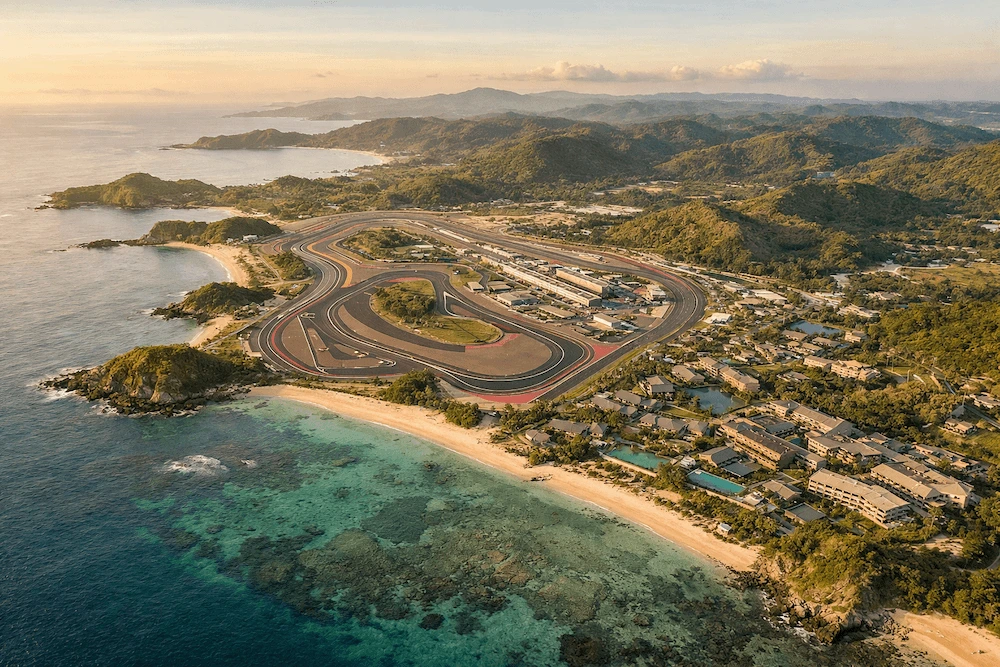
If there is one zone where global “cool factor” meets serious capital formation, it is Mandalika. Located on the southern coast of Lombok, the Mandalika SEZ is no longer a blueprint on a government map. It is a functioning international destination drawing visitors, investors, and international sporting events.
The MotoGP Effect
The Mandalika International Street Circuit has transformed what was once a quiet coastal area into a global motorsports destination. This single asset creates a predictable annual “peak season” that generates reliable high-occupancy windows for hotels, serviced apartments, and short-term rental properties. For an investor building a revenue model, that kind of scheduled demand is invaluable.
Infrastructure Already in Place
Unlike many remote investment zones in Southeast Asia, Mandalika SEZ Lombok already has functioning road networks, power grids, and water systems. The costly and time-consuming infrastructure phase that typically deters early movers is largely complete.
Strategic Investment Districts
The zone is divided into clearly defined districts: the Circuit District (entertainment and events), the Kuta District (retail and dining), and the Tanjung Aan District (premium, low-density resort development). Each district serves a distinct market segment and investor profile.
Where the Secondary Opportunity Lies
While large-scale 5-star resort brands are already securing their positions, a secondary and arguably more agile market is emerging. Boutique lifestyle hotels, high-end food and beverage concepts, and well-designed glamping operations targeting affluent younger travelers following the motorsport and surf circuits represent a compelling niche with lower entry costs and faster ROI cycles.
Sanur Health Wellness Zone (Bali): Where Hospitality Meets Medical Tourism
Sanur holds a distinctive position within the Indonesia tourism SEZ investment landscape. As Bali’s oldest resort area, it carries established brand recognition. As Indonesia’s first designated health and wellness SEZ, it is simultaneously pioneering an entirely new investment category.
The Hybrid Model
The Sanur health wellness zone is not a conventional hospitality play. It blends international-standard medical facilities with premium hospitality infrastructure, creating a hybrid model that serves multiple demand pools: patients, wellness travelers, and long-stay retirees.
Investment Angles Worth Examining
Traditional tourism demand is cyclical and often discretionary. Health and wellness demand operates differently. It is needs-based, frequently recurring, and driven by demographics rather than seasonal sentiment. This makes the Sanur SEZ particularly resilient to the kind of demand swings that affect standard resort markets.
Investors in this zone are exploring three primary product categories. Medical hotels provide accommodation designed for patients undergoing treatment and their accompanying families. Recovery retreats offer high-end, nutrition-focused environments for post-treatment recuperation.
Aging-in-place facilities cater to long-stay retirees from Australia, Japan, and Europe who are drawn to Bali’s climate, culture, and relatively low cost of living.
For investors with a portfolio already weighted toward traditional hospitality, adding a position in the Sanur SEZ offers genuine diversification.
Likupang SEZ (North Sulawesi): Indonesia Tourism SEZ Investment for the Long-Horizon Investor
For those with a longer investment timeline and a genuine commitment to sustainable development, the Likupang SEZ in North Sulawesi represents what many in the industry call the “hidden gem” of Indonesian eco-tourism.
Located at the tip of North Sulawesi, Likupang sits adjacent to the world-renowned Bunaken National Marine Park, one of the most biodiverse marine environments on the planet.
As of 2026, infrastructure links between the regional capital of Manado and the Likupang zone have improved considerably, reducing one of the zone’s historically cited barriers to entry.
Low Density, High Value
The development philosophy here is intentional restraint. Unlike Mandalika’s momentum-driven pace, Likupang is being shaped around low-density, high-value ecological tourism. If Mandalika is defined by “speed” and Sanur by “health,” Likupang is defined by “nature.”
There is a pronounced shortage of luxury eco-lodges in this region, and demand from diving enthusiasts, wildlife travelers, and sustainability-minded high-net-worth individuals is growing steadily.
For investors who see ESG alignment as both a values priority and a marketing advantage, Likupang is one of the most coherent choices available within Indonesia tourism SEZ investment.
SEZ Tax Incentives Indonesia: The “Big Three” Advantages
A recurring question among foreign investors is: why build inside an SEZ rather than simply purchasing land in a desirable location? The answer lies in the cost structure.
The SEZ tax incentives Indonesia offers can reduce an investor’s initial capital outlay by 20% to 30%. Three key instruments drive this:
1. VAT Exemptions
Within a designated SEZ, investors are exempt from the standard 11% Value Added Tax on construction materials and services. On a large-scale hospitality project, this exemption alone can represent savings of hundreds of thousands of dollars.
2. Duty-Free FF&E Imports
Furniture, Fixtures, and Equipment (FF&E) imported for use within an SEZ are brought in duty-free. For a hospitality operation requiring specialized kitchen equipment, custom furniture, or premium finishing materials sourced internationally, this exemption significantly reduces fit-out costs.
3. Corporate Income Tax Holidays
Qualifying investments, typically those starting at around IDR 100 billion, are eligible for a 0% Corporate Income Tax rate for periods of up to 10 years or more. The exact duration depends on the scale and category of the investment.
These incentives make the formal business setup and business licensing process inside an SEZ not just a bureaucratic requirement, but a financially strategic decision.
Managing the Risks: What Every Investor Should Know
No investment environment is without risk, and Indonesia tourism SEZ investment is no exception. However, the nature of the risks has shifted. The barriers are less about national-level regulatory ambiguity and more about local execution.
Licensing and the OSS System
The Online Single Submission (OSS) system is Indonesia’s integrated business licensing platform. It is the primary channel for obtaining a business license in Indonesia SEZ contexts. That said, ground-level permits — zoning confirmations, operational licenses, and location-specific approvals — often still require physical coordination with local government offices. Investors are strongly advised to retain qualified local legal and operational representation from the outset.
Community Relations
The hospitality projects that have performed best in Indonesia, both financially and reputationally, are those that have integrated meaningfully with the local community structures, whether the Banjar system in Bali or the Desa (village) governance structures elsewhere. This is not merely a goodwill consideration. In many cases, community cooperation is a practical prerequisite for smooth operations and long-term stability.
Environmental Compliance
Indonesia’s environmental regulations have been significantly tightened heading into 2026. The AMDAL (Environmental Impact Assessment) process is now more rigorous, and enforcement around waste management and ecological impact has strengthened. Investors who attempt to cut corners in this area face the risk of heavy fines and operational disruptions. Structuring environmental compliance into the project from day one is non-negotiable.
How to Structure an Indonesia Tourism SEZ Investment
The standard vehicle for foreign participation in an Indonesia tourism SEZ investment is the PT PMA (Penanaman Modal Asing), or Foreign-Owned Company. Within an SEZ, the PT PMA Indonesia setup process is considerably expedited compared to the standard national procedure.
Through a PT PMA, foreign investors can hold ownership of buildings and secure long-term land rights through the Hak Guna Bangunan (HGB), or Right to Build, title. Within SEZ frameworks, these titles can be secured for periods of up to 80 years, providing the tenure security that institutional and sophisticated private investors require.
For investors who are new to the Indonesian market, the intersection of business setup, business licensing, and land structuring can appear complex. The good news is that inside an SEZ, these processes are more clearly mapped and supported than they are in general Indonesian territory.
Conclusion: The Window Is Open, but It Is Moving
Indonesia tourism SEZ investment in 2026 represents one of the more compelling value propositions available in Southeast Asian hospitality. The government has invested heavily in infrastructure, the incentive framework is real and material, and the three primary zones (Mandalika, Sanur, and Likupang) each serve distinct investor profiles and risk appetites.
What unifies all three opportunities is the importance of structured entry. Getting the business setup right, securing the correct business license in Indonesia’s SEZ framework, and understanding both the incentives and the compliance obligations determines whether an investment performs as modeled.
Early-mover advantages in Mandalika and Sanur, in particular, are narrowing as 2026 progresses and larger institutional capital secures its positions. For investors who have been evaluating Indonesia as a destination, the question is shifting from “whether” to “how soon” and “through which structure.”

Article By
Tjhia Edy Tarlesno, SH, LLM.
Edy is COO of Business Hub Asia with 20+ years’ experience in legal, compliance, and foreign investment, leading operations and regulatory strategy across Indonesia and Southeast Asia.
Business Hub Asia helps you set up, run, and grow your business in Indonesia & Southeast Asia.
Talk to an ExpertFrequently Asked Questions
What is an Indonesia tourism SEZ investment and how is it different from standard property investment in Indonesia?
An Indonesia tourism SEZ investment refers to establishing or funding a hospitality or tourism-related business within a government-designated Special Economic Zone. Unlike standard property investment, SEZ investments benefit from a distinct regulatory environment, including tax holidays, VAT exemptions on construction, and duty-free equipment imports. The business licensing process is also significantly streamlined through dedicated SEZ administrative bodies.
Can foreign investors fully own a hospitality business inside an Indonesian SEZ?
Yes. Foreign investors can establish a PT PMA (Foreign-Owned Company) to own and operate a hospitality business within an SEZ. A PT PMA in Indonesia is the standard legal vehicle for foreign ownership and can hold building ownership rights (HGB) for up to 80 years within SEZ frameworks, providing long-term tenure security.
What are the main SEZ tax incentives Indonesia offers for tourism investors?
The primary incentives include exemption from the 11% VAT on construction materials and services within the zone, duty-free importation of Furniture, Fixtures, and Equipment (FF&E), and Corporate Income Tax holidays of 0% for up to 10 or more years for qualifying investment sizes. Together, these incentives can reduce initial capital requirements by 20% to 30%.
What is the minimum investment required to qualify for a tax holiday in an Indonesian SEZ?
While specific thresholds can vary by zone and investment category, tax holidays are generally available for investments starting at approximately IDR 100 billion. Investors should verify the current thresholds with the relevant SEZ authority and their legal advisors, as requirements are subject to periodic regulatory updates.
How does the business licensing process work inside an Indonesia SEZ?
Business licensing inside an Indonesian SEZ is processed primarily through the Online Single Submission (OSS) system, Indonesia’s integrated digital licensing platform. SEZ-based applications benefit from a streamlined, fast-tracked process compared to standard national procedures. However, investors are advised to retain local legal representation to manage ground-level permits and coordinate with local government offices as needed.
What is the Sanur health wellness zone and why is it significant for investors?
The Sanur health wellness zone is Indonesia’s first SEZ designated specifically for health and wellness tourism. It integrates international-standard medical facilities with premium hospitality infrastructure, enabling investors to target markets such as medical tourism, post-treatment recovery retreats, and long-stay retirees. Its needs-based demand profile makes it more resilient to the seasonal fluctuations that affect conventional tourism investments.
What are the key risks to be aware of before committing to an Indonesia tourism SEZ investment?
The primary risk areas include local licensing execution (ground-level permits beyond the OSS system), community relations with local village or Banjar governance structures, and environmental compliance under Indonesia’s increasingly rigorous AMDAL regulations. Investors who engage qualified local partners for legal, operational, and community liaison functions from the outset are substantially better positioned to avoid costly delays and compliance issues.
Get in Touch With Our Team
Let us know how we can assist with your company formation or expansion.
Start Your SEA Market Entry with Confidence
Business Hub Asia is ready to help you navigate Indonesia, Vietnam, and Philippines regulations, from business licensing and product registration to workforce management. With an efficient, accurate, and business-focused approach.
Disclaimer
The content provided on this website is published by PT. Bisnis Hub Asia (“we“, or “us“) for general informational purposes only. While every effort is made to ensure the accuracy and timeliness of the information presented, we make no representations or warranties, express or implied, as to the completeness, accuracy, reliability, suitability, or availability of any content, products, or services described on this website. Any reliance placed on such information is strictly at the user’s own risk.
We are a private, independent entity and are not affiliated with, authorized by, or acting on behalf of the Government of the Republic of Indonesia, its ministries, agencies, or any officially appointed representatives. This website does not provide, offer, or promote any official government documents or services, including but not limited to:
Business identification numbers (Nomor Induk Berusaha – NIB);
Tax refunds or rebates;
Stay Permit or electronic travel authorizations;
Passports or other immigration-related documents.
Any references to such services are provided solely for general informational purposes and should not be construed as an offer or facilitation of official services.
We are committed to ensuring the protection of your personal data in accordance with Law No. 27 of 2022 on Personal Data Protection. Any personal information collected through this website will be processed for the purposes clearly stated in our [Privacy Statement]. We do not sell or misuse personal data under any circumstances.
By accessing and using this website, you acknowledge and agree to the terms set out in this Disclaimer. You further agree to use this website and the information provided responsibly and in compliance with applicable laws and regulations.
For further information or questions regarding this Disclaimer, please contact us via the channels provided on our Contact page.
You May Also Like
Stay informed with our latest insights, guides, and articles on doing business in Southeast Asia.
Business License
PB UMKU OSS: A Foreign Investor’s Guide to Business Licensing in Indonesia
Tjhia Edy Tarlesno, SH, LLM. • September 22, 2026
Business License
Business License in Indonesia: The Sectors OSS Alone Cannot Clear
Tjhia Edy Tarlesno, SH, LLM. • August 28, 2026
Business License
Indonesia Business License After NIB: What You Still Need to Operate Legally

Fahri Ramanda Putra • May 25, 2026