




Choosing a KBLI Code You Can Actually Operate Under
August 26, 2026
•
8 minutes read
Content
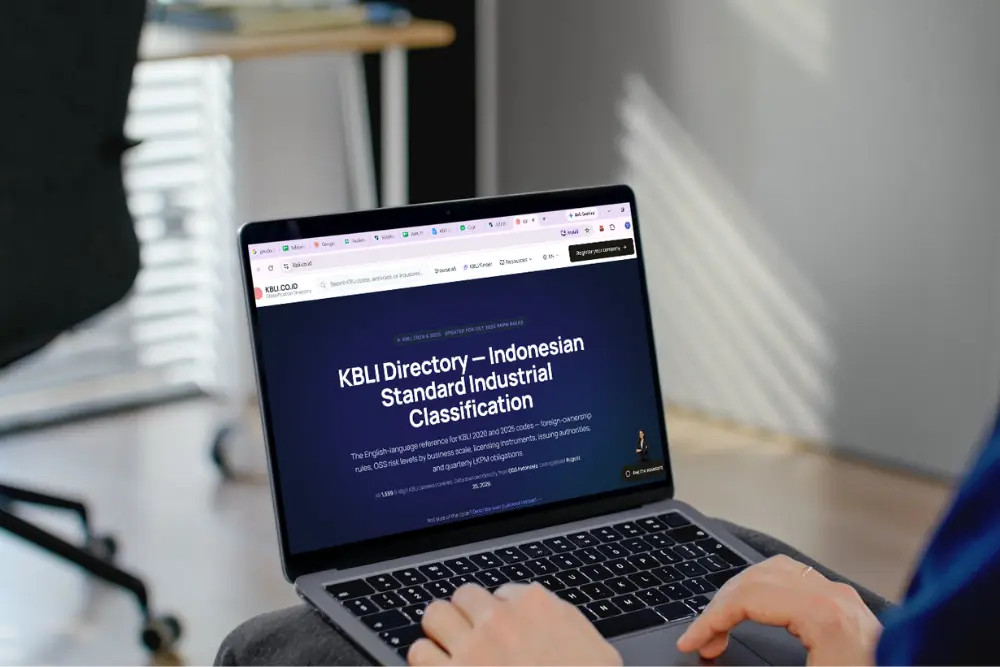
This guide is written for founders and directors setting up a PT PMA (Perseroan Terbatas Penanaman Modal Asing, a foreign-owned limited liability company) or a local PT in Indonesia, and for teams renewing an existing license. After reading it, they will know how to choose a KBLI Code that matches daily operations, not just paperwork.
A KBLI Code, short for Klasifikasi Baku Lapangan Usaha Indonesia, is the five-digit classification that tells the OSS (Online Single Submission) system, the tax office, and sector ministries what a company is licensed to do. Choosing the wrong one can block licensing altogether.
In practice, the KBLI Code written on a company deed is often technically valid. It matches an official title in the book. The real problem shows up in the scope description underneath that title, which frequently does not cover what the company actually sells, a gap a first read of the regulation will not reveal.
Business Hub Asia works through exactly this gap every week, cross-checking planned business activities against KBLI descriptions and OSS requirements before incorporation, not after a rejection. Its Business Licensing & KBLI Advisory service was built around this exact recurring problem.
What Is a KBLI Code and Why Does OSS Care About the Exact Match?
KBLI Code is established based on Peraturan Badan Pusat Statistik (BPS) No. 7 Tahun 2025, issued 17 December 2025, and it fully replaced the earlier KBLI 2020 edition.
KBLI 2025 was built to align with the United Nations’ International Standard Industrial Classification Revision 5. Article 5 of the regulation gives businesses and the OSS system six months from the enactment date to fully transition to the new codes, according to the official regulation text on JDIH.
Every NIB (Nomor Induk Berusaha, or Business Identification Number) issued through OSS is tied to one or more KBLI Codes. If daily operations later drift from the registered code, licenses, tax reporting, and even import permits can be challenged during an audit.
The Most Common Mistake: Choosing a Kode KBLI by Its Title Alone
The single most repeated mistake is selecting a Kode KBLI because its title contains a familiar word. A company selling herbal supplements online, for example, might pick a code titled “retail trade” simply because the word appears in the heading.
The title rarely tells the full story since each KBLI entry carries a longer scope note explaining what is included, and just as often, what is explicitly excluded from that code. Skipping that note is how most mismatches happen.
How to Read a KBLI Description Properly, Not Just the Title
Every KBLI Code in the official book carries a scope description beneath its title, listing included activities, excluded activities, and sometimes cross-references to related codes that may fit the business better.
Reading only the OSS dropdown label is not enough either. The full scope description inside OSS often runs several sentences and determines whether a supplementary activity, such as packaging or private labeling, is already covered or needs its own code.
Quick Answer: How to Match a Business Activity to the Right KBLI Code
A KBLI Code fits a business only when all of the following are true at once:
- The code’s full scope description, not just its title, covers every planned revenue stream.
- The code is checked against the current Positive Investment List for foreign ownership limits.
- The risk level assigned to that code in OSS is understood, since it decides the licensing pathway.
- Any additional technical requirement from a supervising sector ministry has been identified.
- If ownership is restricted, an adjacent open code has been evaluated before considering a local partner.
OSS KBLI and the Positive Investment List: When a Code Comes With Limits
Not every KBLI code is open to every foreign investor. Indonesia’s Positive Investment List, set out in Perpres No. 10 Tahun 2021 and amended by Perpres No. 49 Tahun 2021, designates which sectors are open, restricted, or reserved for cooperatives and small businesses.
The amendment sharply cut the number of sectors carrying foreign ownership caps or partnership requirements, down to 46 sectors from the far longer list under the earlier regulation, per the amended Perpres on the BPK legal database.
Some codes also sit under a specific ministry’s technical rules on top of the Positive Investment List. A code tied to food processing, for instance, may need a separate technical approval from the relevant ministry before an OSS license becomes fully effective.
Check KBLI Status: How to Confirm Whether a Code Is Open to Foreign Ownership
Before incorporation, a KBLI Code under consideration should be checked against three sources at once: the OSS system itself, the current Positive Investment List annex, and any sector-specific regulation from the supervising ministry.
The OSS portal displays foreign ownership status directly against each code during the registration simulation, before a company is formally set up. This step catches most limitations early, though it does not replace a full legal review of ministry-level rules.
Business Hub Asia runs this three-way check for clients before a single document is signed, through its business setup and licensing services, so an ownership limitation surfaces at the planning stage rather than after the notary appointment.
Related articles:
- KBLI 2025 vs KBLI 2020: How to Read Your NIB and Confirm Compliance
- KBLI Indonesia: Why This Business Classification Code Can Make or Break Your Market Entry
What Happens If the KBLI Code is restricted to Foreign Investors?
When a preferred Kode KBLI is closed or restricted for foreign capital, the first option is an adjacent code covering a similar activity that remains open. Many activity groups include several related codes carrying different ownership statuses.
If no open alternative exists, the remaining route is a fully locally owned entity, structured properly under Indonesian law. Arrangements that disguise real foreign control behind a local name are prohibited under Indonesian investment law and carry serious legal risk for everyone involved.
A properly structured local partnership, evaluated with a licensed advisor before any capital changes hands, is the route worth exploring.
Understanding Risk Levels Under OSS KBLI: Low, Medium-Low, Medium-High, and High
Every KBLI Code carries a pre-assigned risk level inside OSS-RBA (Online Single Submission Risk Based Approach). This level, not the applicant’s preference, decides the licensing pathway, under PP No. 28 Tahun 2025, which replaced PP No. 5 Tahun 2021 on 5 June 2025 while keeping the same four-tier structure.
| Risk Level | Indonesian Term | Licensing Requirement |
| Low | Risiko Rendah | NIB only |
| Medium-Low | Risiko Menengah Rendah | NIB plus a self-declared Certificate of Standard |
| Medium-High | Risiko Menengah Tinggi | NIB plus a verified Certificate of Standard |
| High | Risiko Tinggi | NIB plus a verified Izin (license) |
The level determines whether a Certificate of Standard or a full Izin (license) is required before the company can legally start operating, not just register.
KBLI Code Examples by Risk Level: Low, Medium, and High
The table below shows how the four risk tiers translate into real KBLI Codes and real licensing steps, so the categories above are easier to picture against an actual business.
| Risk Level | Example KBLI Code & Activity | What’s Needed Before Operating |
| Low | 47761, retail trade of cut flowers and flower arrangements | NIB only |
| Medium-Low | 55900, other accommodation services (e.g. guesthouses, homestays) | NIB + self-declared Certificate of Standard |
| Medium-High | 41011, residential building construction | NIB + verified Certificate of Standard |
| High | 08101, coal mining, and pharmaceutical manufacturing (KBLI 21 group) | NIB + verified Izin |
The same activity can also shift tiers with scale. A small restaurant under 50 seats is often assessed as low risk, while a larger restaurant of the same KBLI Code can be pushed into a medium-low or medium-high tier once seating, capital, or processing volume increases. The Kode KBLI is only half of the risk calculation; the scale entered in OSS is the other half.
Why a Medium-High or High Risk KBLI Code Delays Commercial Activity
For medium-high and high risk activities, the NIB alone does not authorize commercial operations. It only authorizes preparation, such as construction, equipment installation, or facility setup, while the verified certificate or izin is processed.
The gap between NIB issuance and clearance for commercial activity is tentative. It depends on the sector, the completeness of technical documents, and how quickly the supervising ministry verifies the submission. In our experience, this verification stage is where most delays originate, not the KBLI selection itself.
Business Hub Asia sequences this verification stage alongside company setup through its business licensing consultation services, so clients are not caught planning a launch date before the certificate or izin has actually cleared.
Lessons From the Field: How a Mismatched KBLI Code Plays Out
The scenarios below are composite examples drawn from recurring patterns, not any single client file, and are shared to illustrate how the mistakes above actually surface during registration.
Case 1: One Business, Two Activities, One Code
A specialty coffee roaster set up a café with dine-in service and also planned to sell roasted beans wholesale to other cafés. It registered a single KBLI Code covering food and beverage service, assuming the wholesale sales fell under the same license. A routine OSS review flagged the wholesale deliveries as unlicensed activity, since bulk sales to other businesses sit under a separate trading code. The company had to add a second KBLI Code and update its NIB before wholesale orders could continue.
Case 2: The Risk Level Surprise
A restaurant group planned to open with dine-in seating for around 80 guests. Because seating above roughly 50 pushes a restaurant’s Kode KBLI into a higher risk band, the company needed a verified Certificate of Standard, not a self-declaration, before serving customers. The founders had budgeted for a same-week opening based on the NIB date alone, not the added verification step that came with their scale.
Case 3: The Ownership Limitation
A digital consulting firm with foreign shareholders wanted one KBLI Code covering both software development and a data processing activity restricted under the Positive Investment List. Instead of an informal local nominee to bypass the restriction, the firm split its scope across two codes: an open code for software development, and a separately reviewed local partnership structure for the restricted activity.
Get the Right KBLI Code Before You Register, Not After
A KBLI Code chosen with the full scope description, sector limitations, and risk level in mind saves months of correction later. Getting it right from the start keeps a company’s licensing timeline, and its ability to operate legally, on track.
Business Hub Asia’s Business Licensing & KBLI Advisory service reviews planned activities against KBLI 2025, the current Positive Investment List, and OSS risk tiers before incorporation begins, catching mismatches while they are still easy to fix.
Book a KBLI Code and business licensing consultation with Business Hub Asia’s foreign-owned company registration and licensing team to confirm the right classification before filing with OSS.

Article By
Tjhia Edy Tarlesno, SH, LLM.
Edy is COO of Business Hub Asia with 20+ years’ experience in legal, compliance, and foreign investment, leading operations and regulatory strategy across Indonesia and Southeast Asia.
Business Hub Asia helps you set up, run, and grow your business in Indonesia & Southeast Asia.
Talk to an ExpertFrequently Asked Questions
What is a KBLI Code?
A KBLI Code is the five-digit number from Klasifikasi Baku Lapangan Usaha Indonesia that classifies a specific business activity for OSS licensing, tax registration, and sector oversight in Indonesia.
What is the difference between KBLI 2020 and KBLI 2025?
KBLI 2025, set out in Peraturan BPS No. 7 Tahun 2025, replaced KBLI 2020 entirely and realigned Indonesia’s classification structure with the UN’s ISIC Revision 5 standard.
How many KBLI Codes are there?
The prior KBLI 2020 edition listed roughly 1,790 five-digit codes. KBLI 2025 revised this structure again, so current filings should reference the updated 2025 code list rather than the 2020 numbers.
Where can someone Check KBLI status for foreign ownership?
The OSS system displays foreign ownership status against each Kode KBLI during registration, alongside the Positive Investment List annex under Perpres No. 10 Tahun 2021 as amended by Perpres No. 49 Tahun 2021.
What is OSS KBLI?
OSS KBLI describes how a Kode KBLI functions once entered into Indonesia’s Online Single Submission licensing system, where it determines risk level, ownership eligibility, and required certificates.
Can a foreign investor use a KBLI Code that is closed to foreign capital?
No. A closed code cannot be used by a foreign-owned entity. The alternatives are an open adjacent code or a properly structured, fully local entity, never an informal nominee arrangement.
What is the risk level system under OSS KBLI?
Every code carries a pre-set risk level: low, medium-low, medium-high, or high, under the risk-based licensing framework in PP No. 28 Tahun 2025, determining whether a Certificate of Standard or Izin is required.
Can a company start selling immediately after getting its NIB?
Only for low risk codes. Medium-high and high risk codes require a verified Certificate of Standard or Izin before commercial activity, not just the NIB.
What does PT PMA mean?
PT PMA stands for Perseroan Terbatas Penanaman Modal Asing, meaning a limited liability company with foreign investment, Indonesia’s standard vehicle for foreign-owned businesses.
What happens if the wrong KBLI Code is registered?
Operating under a mismatched code can trigger license challenges during audits, blocked import permits, or a forced business activity change, which is often slower,more disruptive and costly than choosing correctly at the start.
Get in Touch With Our Team
Let us know how we can assist with your company formation or expansion.
Start Your SEA Market Entry with Confidence
Business Hub Asia is ready to help you navigate Indonesia, Vietnam, and Philippines regulations, from business licensing and product registration to workforce management. With an efficient, accurate, and business-focused approach.
Disclaimer
The content provided on this website is published by PT. Bisnis Hub Asia (“we“, or “us“) for general informational purposes only. While every effort is made to ensure the accuracy and timeliness of the information presented, we make no representations or warranties, express or implied, as to the completeness, accuracy, reliability, suitability, or availability of any content, products, or services described on this website. Any reliance placed on such information is strictly at the user’s own risk.
We are a private, independent entity and are not affiliated with, authorized by, or acting on behalf of the Government of the Republic of Indonesia, its ministries, agencies, or any officially appointed representatives. This website does not provide, offer, or promote any official government documents or services, including but not limited to:
Business identification numbers (Nomor Induk Berusaha – NIB);
Tax refunds or rebates;
Stay Permit or electronic travel authorizations;
Passports or other immigration-related documents.
Any references to such services are provided solely for general informational purposes and should not be construed as an offer or facilitation of official services.
We are committed to ensuring the protection of your personal data in accordance with Law No. 27 of 2022 on Personal Data Protection. Any personal information collected through this website will be processed for the purposes clearly stated in our [Privacy Statement]. We do not sell or misuse personal data under any circumstances.
By accessing and using this website, you acknowledge and agree to the terms set out in this Disclaimer. You further agree to use this website and the information provided responsibly and in compliance with applicable laws and regulations.
For further information or questions regarding this Disclaimer, please contact us via the channels provided on our Contact page.
You May Also Like
Stay informed with our latest insights, guides, and articles on doing business in Southeast Asia.
Company Registration
Nominee Shareholder Arrangements in Indonesia: Legal Options for Foreign Investors

Daris Salam • October 2, 2026
Company Registration
Open a Company in Indonesia: How PP No. 30/2026 Impacts Foreign Setup Costs
Tjhia Edy Tarlesno, SH, LLM. • September 23, 2026
Company Registration
Corporate Bank Account Opening in Indonesia: Conventional or Digital Bank

Fahri Ramanda Putra • September 16, 2026