








Green Special Economic Zones in Indonesia: The Sustainable Industrial Frontier of 2026
4 月 22, 2026
•
阅读时间:6分钟
内容
The image of industrial progress has undergone a radical transformation. Only a decade ago, industrial zones were synonymous with smoke-filled horizons and heavy environmental footprints. However, as we move through 2026, the global manufacturing paradigm has shifted toward sustainability. For modern Multi-National Corporations (MNCs), particularly those in the high-precision medical device and healthcare sectors, Environmental, Social, and Governance (ESG) compliance is no longer a secondary consideration.
It has become a mandatory operational standard. Indonesia has strategically anticipated this shift by reimagining its industrial clusters. By developing Green Special Economic Zones in Indonesia, the nation is positioning itself as the premier destination for sustainable investment and sophisticated manufacturing in Southeast Asia.
For foreign medical device manufacturers and healthcare distributors, this evolution represents more than just environmental stewardship; it represents a reduction in long-term risk. Entering a market like Indonesia requires a robust understanding of how these green zones facilitate a smoother business set up and ensure that every business license acquired aligns with future-proof global standards.
As the world demands greener supply chains, Indonesia’s specialized zones offer a turnkey solution for companies looking to expand their footprint while maintaining impeccable ESG credentials.
The Strategic Roadmap: Transitioning Toward Green Special Economic Zones in Indonesia
Indonesia’s journey toward sustainable industrialization is not merely a collection of policy promises. It is a structured transition backed by significant international partnerships. A pivotal moment in this trajectory was the formal collaboration between the National Council for SEZs and the Global Green Growth Institute (GGGI).
Since the expansion of their Memorandum of Understanding in 2024, the focus has shifted toward making these zones “future-proof.”
When an investor initiates a business set up in an Indonesian SEZ today, they are not just renting space; they are integrating into an ecosystem designed to meet the carbon-neutral standards of 2045. A Green SEZ is characterized by several core pillars that are particularly attractive to the healthcare industry.
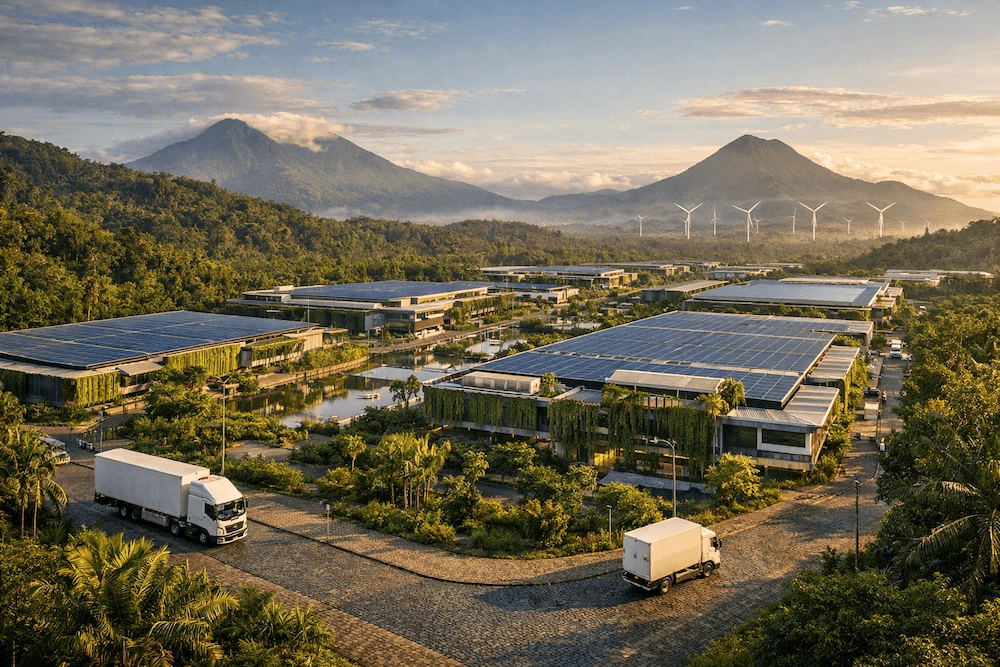
These include renewable energy grids that utilize solar, geothermal, and biomass power instead of traditional coal. Furthermore, these zones implement circular economy principles where industrial waste, such as excess heat or chemical byproducts, is repurposed as raw materials for neighboring facilities. This synergy reduces costs and enhances the sustainability profile of the entire zone.
Why Healthcare and Medical Device Firms Prefer Green Special Economic Zones in Indonesia
For medical device manufacturers, the environment in which production occurs is critical. The precision required for medical instrumentation and the sterile conditions needed for pharmaceutical production demand stable, high-quality infrastructure.
Green Special Economic Zones in Indonesia provide this through green building standards. Infrastructure built with sustainable materials often reduces energy consumption by up to 30 percent, providing a more stable and cost-effective power supply for sensitive machinery.
Furthermore, healthcare companies are under increasing pressure from international regulators to prove that their products are manufactured ethically. By operating within a zone that prioritizes ESG compliance Indonesia, manufacturers can leverage the zone’s existing certifications.
This simplifies the process of obtaining an international business license for export, as the “green” credentials of the manufacturing site are already verified by the Indonesian government and its international partners.
Case Study: Sei Mangkei and Sustainable Supply Chain Excellence
If one wishes to see the practical application of a Green SEZ, the Sei Mangkei SEZ in North Sumatra serves as the primary example. It has become the gold standard for sustainable supply chains in the region. Originally known as a hub for the palm oil industry, it has evolved into a sophisticated bio-refinery center.
Investors in Sei Mangkei benefit from a pre-certified sustainable ecosystem. For medical firms that utilize oleochemicals or bio-based polymers in their packaging and products, this zone offers a direct link to raw materials that are produced under strict environmental oversight.
This makes it significantly easier to export products to the European Union and North America, where proof of sustainability is mandatory. Beyond environmental factors, the zone integrates Fairtrade schemes for local fishery and agricultural products, ensuring that the “Social” component of ESG is addressed at the source.
Morowali and Nusantara: New Frontiers for Green Special Economic Zones in Indonesia
The Indonesian government is currently proposing and developing new zones that are “Green from Day One.” Two prominent examples are Morowali and the new capital, Nusantara (IKN).
- Morowali: The Green Metals Hub. While historically known for nickel mining, the 2026 focus has shifted toward clean energy development. To maintain a competitive edge in the Electric Vehicle (EV) battery market and the production of medical-grade stainless steel, Morowali is transitioning its smelting processes to use cleaner energy sources. This ensures that the healthcare equipment of the future is not manufactured using “dirty” energy.
- Nusantara SEZ (IKN): The Energy Supply Hub. The new capital is designed as a “Forest City,” and the accompanying Nusantara SEZ serves as a high-tech laboratory for renewable energy. For healthcare companies interested in Research and Development (R&D), this zone offers an unparalleled environment for testing new green technologies and sustainable medical solutions within the ASEAN region.
Navigating Regulatory Frameworks: Licensing and Compliance
确保 business license in Indonesia involves navigating a specific set of regulations designed to encourage local growth and environmental responsibility. In Green Special Economic Zones in Indonesia, these regulations are often streamlined to attract high-quality foreign investment.
One critical aspect is the TKDN requirements (Local Content Requirements). Indonesia encourages the use of local materials and labor. In green zones, using locally produced solar panels or sustainable building materials can help companies meet these quotas more efficiently.
Additionally, Indonesia is home to one of the world’s largest carbon credit potentials. Manufacturing in a Green SEZ may eventually allow firms to offset their remaining emissions through local carbon exchange programs, a major benefit for companies aiming for “Net Zero” targets.
这 business set up process in these zones is typically managed through a “One-Stop Service” (OSS) system. This centralized approach reduces bureaucratic hurdles, allowing healthcare distributors and manufacturers to obtain their operational permits faster than they would in non-specialized zones.
The Business Case: Why “Going Green” is Profitable in 2026
A common question among institutional investors is whether the transition to green energy increases the cost of entry. While the initial setup costs for sustainable infrastructure can be slightly higher, the medium-term Return on Investment (ROI) is far superior for several reasons:
- Lower Operational Costs: Smart grids and renewable energy sources significantly reduce long-term electricity bills, which are often the highest overhead for manufacturing plants.
- Enhanced Market Access: Sustainable products sell at a premium and face fewer trade barriers in Western markets, ensuring a smoother export path for medical devices.
- Access to Greener Capital: Many global banks and “Green Bonds” offer lower interest rates to companies operating within certified sustainable zones, reducing the cost of debt.
By choosing to operate within Green Special Economic Zones in Indonesia, companies are effectively “future-proofing” their assets against upcoming carbon taxes and stricter environmental regulations.
Conclusion: Securing Your Place in Indonesia’s Sustainable Future
The shift toward green manufacturing is accelerating, and the window for “first-mover” advantages is narrowing. By 2030, Indonesia aims for a significant portion of its SEZs to be powered entirely by renewable energy, with a goal of a fully “Net Zero” industrial ecosystem by 2045.
For the foreign investor, entering Green Special Economic Zones in Indonesia now is a strategic play. You are not simply purchasing land; you are securing a position within a sustainable global supply chain that will soon be the only viable way to conduct international business.
The Indonesian government remains committed to supporting foreign medical device manufacturers and healthcare companies through favorable tax incentives and streamlined licensing. Don’t get left behind with “stranded assets” in non-compliant zones. The future of industrial success in Southeast Asia is undeniably green.
联系我们的团队
请让我们知道我们如何协助您的公司成立或扩张。
自信地进入东南亚市场
亚洲商业中心随时准备帮助您了解印度尼西亚、越南和菲律宾的法规,涵盖从营业执照、产品注册到劳动力管理等各个方面。我们采用高效、准确且以业务为中心的方法。
免责声明
本网站提供的内容由 PT. Bisnis Hub Asia (“我们“, 或者 ”我们”)仅供一般参考之用。尽管我们已尽一切努力确保所提供信息的准确性和及时性,但我们不对本网站所述任何内容、产品或服务的完整性、准确性、可靠性、适用性或可用性作出任何明示或暗示的陈述或保证。任何依赖此类信息的风险均由用户自行承担。
我们是一家 私人、独立实体 并且 不隶属于, 授权, 或者 代表 印度尼西亚共和国政府、其各部委、机构或任何官方指定的代表。本网站不 不是 提供、提供或推广任何官方政府文件或服务,包括但不限于:
企业识别号(Nomor Induk Berusaha – NIB);
退税或返还;
居留许可或电子旅行授权;
护照或其他与移民相关的文件。
对此类服务的任何引用仅供一般参考,不应被视为官方服务的提供或便利。
我们致力于确保按照以下规定保护您的个人数据 2022年第27号《个人数据保护法》任何通过本网站收集的个人信息,都将按照我们[隐私声明]中明确规定的用途进行处理。在任何情况下,我们都不会出售或滥用个人信息。
访问并使用本网站,即表示您确认并同意本免责声明中所列的条款。您进一步同意以负责任的方式使用本网站及其所提供的信息,并遵守适用的法律法规。
如需了解有关本免责声明的更多信息或有任何疑问,请通过我们的联系页面提供的渠道与我们联系。
你可能还喜欢
随时了解我们关于在东南亚开展业务的最新见解、指南和文章。
营业执照
Business License in Indonesia: The Sectors OSS Alone Cannot Clear

Tjhia Edy Tarlesno, SH, LLM. • 8 月 28, 2026
营业执照
Indonesia Business License After NIB: What You Still Need to Operate Legally

Fahri Ramanda Putra • 5 月 25, 2026
营业执照
How to Start a Fintech Company in Indonesia: The Complete Guide for Foreign Investors
Fahri Ramanda Putra • 5 月 8, 2026