









KITAS vs. KITAP in Indonesia: Key Differences and How to Upgrade
May 11, 2026
•
9 minutes read
Content
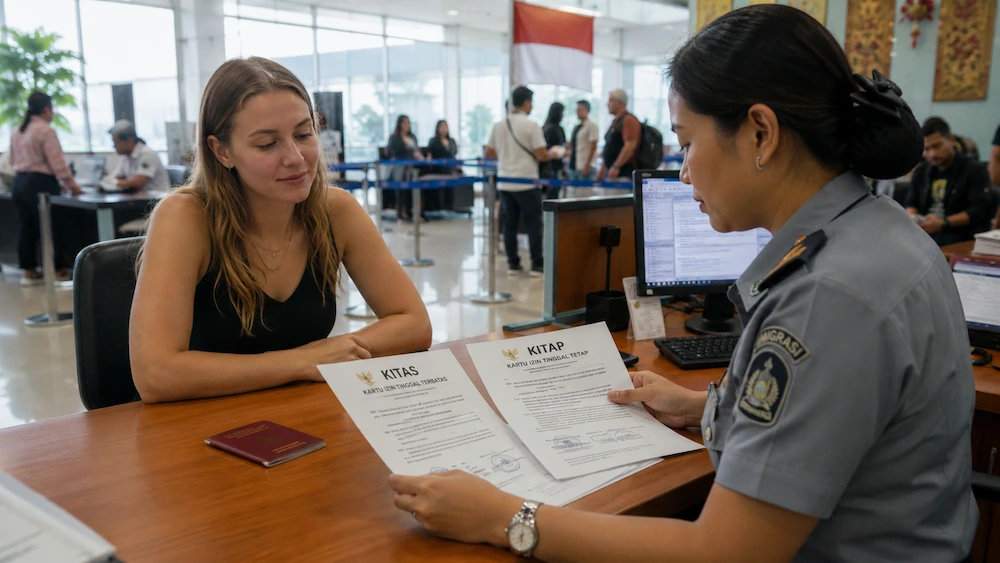
For most expats in Indonesia, a KITAS is simply where the journey begins. After years of renewing paperwork and navigating immigration offices, many long-term residents start asking a fair question: is there a better way?
There is. KITAP Indonesia, the country’s permanent stay permit, dramatically reduces administrative burdens while unlocking rights that a KITAS never could. This article breaks down every meaningful difference, covers who qualifies, and explains exactly how the upgrade works in 2026.
Section 1: What Is KITAS Indonesia?
KITAS stands for Kartu Izin Tinggal Terbatas, which translates to Limited Stay Permit Card. Since 2021, it is also commonly issued in electronic form and referred to as e-ITAS (Electronic Izin Tinggal Terbatas).
A KITAS Indonesia is the standard residence permit for foreigners living in Indonesia on a temporary basis. It is tied to a specific purpose and must be renewed periodically, requiring ongoing coordination with a local sponsor.
Key characteristics:
- Validity: 6 months to 2 years, depending on type
- Renewal required annually (or per validity period)
- Must have a local sponsor (employer, spouse, institution, or investment company)
- Renewal involves documents, immigration office visits, and fees each cycle
Types of KITAS available in 2026:
- Work KITAS
- Investor KITAS
- Retirement KITAS
- Spouse KITAS (for foreign spouses of Indonesian citizens)
- Dependent KITAS
- Second Home KITAS
- Digital Nomad KITAS
Read also: Types of KITAS in Indonesia: The Complete Guide for Expats and Foreign Nationals
Pro Tip: A KITAS is tied to its purpose. Switching jobs or changing your sponsor means your KITAS eligibility resets. This is one reason many long-term residents prioritize upgrading early.
Section 2: What Is KITAP?
KITAP stands for Kartu Izin Tinggal Tetap, meaning Permanent Stay Permit Card. It is now also issued digitally as e-ITAP through Indonesia’s Directorate General of Immigration.
KITAP is the highest residency status available to a foreign national in Indonesia before full citizenship. It offers long-term stability and significantly fewer administrative requirements than KITAS Indonesia.
Key characteristics:
- Validity: 5 years (some categories: 10 years or unlimited)
- Auto-renewable: no annual renewal burden
- Issued and approved by the Directorate General of Immigration and Ministry of Law and Human Rights
- Pathway to Indonesian citizenship after 5 consecutive years
Regulatory Note: KITAP is governed under Law No. 6 of 2011 on Immigration, as amended most recently by Law No. 63 of 2024 (Third Revision). Implementing regulations include Government Regulation No. 48 of 2021 and Ministerial Regulation No. 11 of 2024. (Reference: UNHCR RIMAP: Law No. 6/2011)
Section 3: KITAS vs. KITAP: Side-by-Side Comparison
Understanding the difference between KITAS and KITAP is easier with a direct comparison. The gap is larger than most KITAS holders realize.
| Feature | KITAS Indonesia | KITAP Indonesia |
|---|---|---|
| Full Name | Kartu Izin Tinggal Terbatas | Kartu Izin Tinggal Tetap |
| Meaning | Limited Stay Permit | Permanent Stay Permit |
| Validity | 6 months – 2 years | 5 years (some: 10 yrs / unlimited) |
| Renewal Frequency | Annually or per validity cycle | Every 5 years (auto-renewable) |
| Eligibility | Broad (work, spouse, investor, retirement, etc.) | Must meet consecutive stay threshold |
| Exit Permit Required | Yes (MERP required for travel abroad) | No MERP required |
| Path to Citizenship | No | Yes, after 5 years |
| Indonesian ID (KTP) | Not eligible | Eligible to apply |
| Banking Access | Standard | Often preferential |
| Work Rights | Depends on KITAS type | Spouses of Indonesians can work under certain conditions |
| Sponsor Required | Yes | Yes (for most types) |
| Application Process | Annual renewal cycle | One-time upgrade, 7–9 week process |
| Civil ID Eligibility | SKTT (temporary residency card) | e-KTP Orang Asing (national ID, valid 5 years) |
2025 Compliance Update: As of 2025, the Ministry of Law and Human Rights requires in-person biometric verification (photo and interview) for KITAS and KITAP renewals. KITAS holders must register with the local civil authority (Disdukcapil) within 7 to 14 days of permit issuance to obtain an SKTT (temporary residency card). KITAP holders must obtain an e-KTP Orang Asing, a chip-based national ID aligned with Indonesia’s national population database. (Source: CPT Corporate Press Release, October 2025)
Section 4: KITAP Eligibility Requirements Indonesia
Not every KITAS holder qualifies for KITAP. Understanding the KITAP eligibility requirements Indonesia sets out is the most critical first step.
General eligibility criteria:
- Minimum 3 consecutive years on the same KITAS type (Work, Investor, Spouse, Retirement, Second Home)
- Continuous stay in Indonesia is required; significant gaps or re-entry issues may disqualify the applicant
- Must hold a KITAP-eligible KITAS type (tourist-derived stays or short-term VoA conversions are not valid pathways)
- A valid Indonesian sponsor or guarantor is required
- No active immigration violations on record
Eligibility by KITAS type:
| KITAS Type | Minimum Years Required |
|---|---|
| Work KITAS (same employer) | 4 consecutive years |
| Investor KITAS (same PT PMA) | 3 consecutive years |
| Spouse KITAS (Indonesian citizen spouse) | 2 consecutive years |
| Retirement KITAS | 4 extensions (must be 55+) |
| Second Home KITAS | 3 consecutive years |
Pro Tip: Under Permenkumham No. 11 of 2024, the minimum individual share ownership for an Investor KITAS is IDR 10 billion. Investors approaching the KITAP threshold should verify current shareholding requirements directly with an immigration consultant, as thresholds may differ for KITAP eligibility. (Reference: Ministerial Regulation No. 11 of 2024)
Special case: Spouse of Indonesian citizen: After 10 or more years of marriage, a foreign spouse’s KITAP becomes lifetime-valid, even in the event of divorce.
Section 5: KITAP Benefits Indonesia
The KITAP benefits Indonesia offers go well beyond just a longer validity. For long-term residents, the practical differences are significant.
Administrative benefits:
- No annual renewal cycle: renew once every 5 years
- No exit re-entry permits (MERP) required for international travel
- Reduced administrative overhead for sponsoring companies
Lifestyle and financial benefits:
- Eligible to apply for an Indonesian ID card (KTP), valid for 5 years, which is useful for property leasing, local administration, and accessing local rates at public attractions
- Easier access to local banking; some banks extend preferential treatment to KITAP holders
- KITAP holders married to Indonesian citizens can independently apply for work permits under certain conditions
Long-term benefits:
- Pathway to naturalization: after 5 consecutive years on KITAP, a foreign national may apply for Indonesian citizenship
- Greater stability for families, with dependents eligible to apply under family reunification provisions
- Enhanced access to local services including tax registration, civil reporting, and local pricing at government-managed sites
Pro Tip: A KITAP holder is considered a permanent resident under Indonesian law. While it does not confer citizenship, it provides nearly every practical benefit of long-term settlement without requiring naturalization.
Section 6: How to Upgrade KITAS to KITAP: Step by Step
The process of how to upgrade KITAS to KITAP is more structured than a standard KITAS renewal. Applicants must remain in Indonesia throughout the entire process.
Step 1: Confirm eligibility. Check that the required consecutive years have been met on the same KITAS type with the same sponsor, with no gaps.
Step 2: Gather KITAS history documentation. Compile records of all previous KITAS cards and extensions to demonstrate continuity.
Step 3: Prepare required documents.
- Current valid KITAS card
- Full passport history (all pages)
- Sponsor documents (company deed, business license, NPWP, or individual sponsor documents)
- Formal sponsor letter
- Proof of Indonesian address
- Recent passport-sized photographs
- Any additional documents specified by the local immigration office
Step 4: File the application. Submit at the local Kantor Imigrasi (Immigration Office) or Kantor Wilayah (Regional Office). Online submission is available through Indonesia’s official immigration portal at evisa.
Step 5: Review and approval. The application goes through: Local Immigration Office review, then Director General of Immigration review, followed by Ministry of Law and Human Rights approval.
Step 6: Biometrics. Biometric data may be collected if required by the processing office.
Step 7: KITAP card issuance. The physical or electronic KITAP card is issued upon final approval.
Timeline: The full process typically takes approximately 7 to 9 weeks from submission to card issuance, depending on document completeness and office workload.
Critical Note: The KITAS must still be valid at the time of application, with at least 30 days remaining before expiration. Do not wait until the last week of validity to apply.
Section 7: Understanding MERP and Travel Rights for KITAP Holders
One of the most practical aspects of holding a permanent stay permit Indonesia for foreigners is understanding how international travel is managed. Both KITAS and KITAP holders are required to hold a Multiple Exit Re-Entry Permit (MERP), also known as Izin Masuk Kembali (IMK), before leaving Indonesia.
What is MERP and why does it matter?
The MERP is an official immigration endorsement that allows a KITAS or KITAP holder to leave and return to Indonesia legally without losing their permit status. Without a valid MERP, exiting Indonesia while holding a KITAS or KITAP will result in automatic cancellation of the permit.
Key MERP rules every permit holder must know:
- A MERP must be obtained before leaving Indonesia; it cannot be applied for from abroad
- MERP applications can now be submitted online through the official portal at evisa or via the MOLINA application
- Processing time is typically 3 to 5 working days
- MERP is issued in durations of 6 months, 1 year, 2 years, or up to the validity period of the KITAS or KITAP
- If a KITAP holder stays outside Indonesia continuously for more than 1 year, the KITAP may be cancelled under Article 143 of Permenkumham No. 11/2024
Pro Tip: As of December 2024, newly issued KITAPs include a MERP valid for the full 5-year duration of the permit. However, KITAPs issued before this date are subject to the previous 2-year MERP renewal cycle. Holders of older KITAPs should verify their MERP status through the evisa portal.
MERP differences between KITAS and KITAP:
| Aspect | KITAS Holder | KITAP Holder |
|---|---|---|
| MERP Required | Yes | Yes |
| MERP Duration (max) | Up to KITAS validity period | Up to 5 years (for new KITAP, post Dec 2024) |
| Application Method | Online via evisa.imigrasi.go.id | Online via evisa.imigrasi.go.id |
| MERP if staying outside 1+ year continuously | KITAS may lapse | KITAP may be cancelled |
| Exit Permit Only (EPO) needed if leaving permanently | Yes | Yes |
Understanding Exit Permit Only (EPO) vs. MERP:
These two documents are frequently confused. A MERP allows temporary travel abroad while maintaining active permit status. An Exit Permit Only (EPO) is issued when a foreign national is permanently leaving Indonesia and formally closes the KITAS or KITAP. Leaving without an EPO when ending one’s stay can create complications for future visa applications and may expose the sponsor to immigration penalties.
Pro Tip: Immigration enforcement in Indonesia has tightened significantly in 2025. The Directorate General of Immigration has increased compliance checks on KITAS and KITAP holders to ensure their actual activities align with their permit type and sponsoring entity. Staying current on MERP validity and civil reporting obligations is essential to maintaining good standing.
Section 8: Should Someone Upgrade? A Decision Framework
Not every KITAS holder is at the right stage to upgrade. Here is a practical framework.
Upgrade to KITAP if:
- Plans to remain in Indonesia for 3 or more additional years
- The current employer wants to reduce annual administrative overhead
- A pathway to Indonesian citizenship is a long-term goal
- Frequent international travel makes MERP-free movement a priority
- The applicant is a spouse of an Indonesian citizen who has completed 2 years on a Spouse KITAS
Stay on KITAS if:
- The length of stay in Indonesia is still uncertain
- A job or employer change is likely, which would reset the sponsorship clock
- The current KITAS type is not yet KITAP-eligible
- The required consecutive years have not yet been completed
Special consideration for spouses of Indonesian citizens: This group has the shortest eligibility path at 2 years and also gains unique rights, including independent work permit eligibility and, in long marriages (10+ years), lifetime KITAP validity.
Section 9: After KITAP: The Path to Citizenship
For those who eventually want to become Indonesian citizens, KITAP is the mandatory gateway. After holding KITAP for 5 consecutive years, a foreign national may apply for naturalization.
Citizenship application requirements include:
- 5 consecutive years on KITAP without significant absence
- Indonesian language proficiency
- Financial self-sufficiency
- No criminal record in Indonesia or country of origin
- Official application submitted to the Ministry of Law and Human Rights
Note: Naturalization grants full Indonesian citizenship (Warga Negara Indonesia or WNI) and is a separate legal process from KITAP. It does not happen automatically and requires a dedicated application.
A Quick Summary Worth Remembering
Living in Indonesia long-term without upgrading to KITAP means spending years in an avoidable administrative loop. For eligible expats, the upgrade offers more freedom, lower recurring costs, and a stable legal foundation for the future. The 7 to 9 week process is a one-time investment that pays off over decades.

Article By
Tjhia Edy Tarlesno, SH, LLM.
Edy is COO of Business Hub Asia with 20+ years’ experience in legal, compliance, and foreign investment, leading operations and regulatory strategy across Indonesia and Southeast Asia.
Stay updated with market insights
Frequently Asked Questions
What is the main difference between KITAS and KITAP in Indonesia?
KITAS (Kartu Izin Tinggal Terbatas) is a limited stay permit requiring annual renewal, while KITAP (Kartu Izin Tinggal Tetap) is a permanent stay permit valid for 5 years and automatically renewable. KITAP also removes the need for exit permits and opens a path to Indonesian citizenship.
How many years on KITAS are needed before applying for KITAP?
The minimum is 2 consecutive years for spouses of Indonesian citizens, and 3 to 4 consecutive years for other KITAS types such as Work, Investor, Retirement, and Second Home. The same KITAS type and sponsor must be maintained throughout this period without gaps.
Can someone apply for KITAP while still outside Indonesia?
No. The KITAP application must be submitted from within Indonesia, and the applicant must remain in the country throughout the entire processing period.
Does KITAP allow the holder to work in Indonesia?
Work rights depend on the KITAP type. Foreign nationals married to Indonesian citizens may work under a KITAP under certain conditions. Work KITAP holders continue their employment as permitted under their existing work arrangement. Retirement KITAP and Second Home KITAP holders are generally not permitted to work.
How long does it take to get KITAP in Indonesia?
The processing timeline is approximately 7 to 9 weeks from the date of application submission, assuming complete documentation and no issues identified during the review process.
Do KITAP holders still need a MERP to travel abroad?
Yes. All KITAP holders must hold a valid Multiple Exit Re-Entry Permit (MERP) before leaving Indonesia. Exiting without a valid MERP results in automatic cancellation of the KITAP. As of December 2024, newly issued KITAPs include a MERP valid for the full 5-year permit duration. KITAPs issued before that date may still operate under the previous 2-year MERP renewal cycle.
What happens if there is a gap in a KITAS holder’s stay record?
Significant gaps in the consecutive stay period may disqualify the applicant or reset the eligibility clock. It is important to maintain uninterrupted KITAS status and avoid extended absences that could be interpreted as abandoning residency.
Can a KITAP holder apply for an Indonesian ID card (KTP)?
Yes. KITAP holders are eligible to apply for a KTP (Kartu Tanda Penduduk), valid for 5 years. This is particularly useful for property leasing, local administrative processes, and accessing local pricing at certain public facilities.
Is KITAP the same as Indonesian citizenship?
No. KITAP is a permanent residency status, not citizenship. It allows long-term legal residence in Indonesia without the holder becoming an Indonesian citizen. After 5 consecutive years on KITAP, the holder may apply for naturalization, which is a separate formal process through the Ministry of Law and Human Rights.
What Indonesian regulations govern KITAS and KITAP?
The primary legal framework is Immigration Law No. 6 of 2011, as revised by Law No. 63 of 2024 (Third Revision). Implementing regulations include Government Regulation No. 48 of 2021 and Ministerial Regulation No. 11 of 2024 (Permenkumham No. 11/2024). Applications are processed through the Directorate General of Immigration at imigrasi.go.id and the official e-visa portal at evisa.imigrasi.go.id.
Get in Touch With Our Team
Let us know how we can assist with your company formation or expansion.
Start Your SEA Market Entry with Confidence
Business Hub Asia is ready to help you navigate Indonesia, Vietnam, and Philippines regulations, from business licensing and product registration to workforce management. With an efficient, accurate, and business-focused approach.
Disclaimer
The content provided on this website is published by PT. Bisnis Hub Asia (“we“, or “us“) for general informational purposes only. While every effort is made to ensure the accuracy and timeliness of the information presented, we make no representations or warranties, express or implied, as to the completeness, accuracy, reliability, suitability, or availability of any content, products, or services described on this website. Any reliance placed on such information is strictly at the user’s own risk.
We are a private, independent entity and are not affiliated with, authorized by, or acting on behalf of the Government of the Republic of Indonesia, its ministries, agencies, or any officially appointed representatives. This website does not provide, offer, or promote any official government documents or services, including but not limited to:
Business identification numbers (Nomor Induk Berusaha – NIB);
Tax refunds or rebates;
Stay Permit or electronic travel authorizations;
Passports or other immigration-related documents.
Any references to such services are provided solely for general informational purposes and should not be construed as an offer or facilitation of official services.
We are committed to ensuring the protection of your personal data in accordance with Law No. 27 of 2022 on Personal Data Protection. Any personal information collected through this website will be processed for the purposes clearly stated in our [Privacy Statement]. We do not sell or misuse personal data under any circumstances.
By accessing and using this website, you acknowledge and agree to the terms set out in this Disclaimer. You further agree to use this website and the information provided responsibly and in compliance with applicable laws and regulations.
For further information or questions regarding this Disclaimer, please contact us via the channels provided on our Contact page.
You May Also Like
Stay informed with our latest insights, guides, and articles on doing business in Southeast Asia.
Immigration
Mixed Marriage in Indonesia: How to Report Your Marriage the Right Way

Fahri Ramanda Putra • September 3, 2026
Immigration
Visa on Arrival Indonesia: Converting to a Stay Permit Without Leaving
Fahri Ramanda Putra • September 2, 2026
Immigration
Spouse KITAS Indonesia: Applying From Abroad While Your Marriage Is Registered Overseas
Fahri Ramanda Putra • September 1, 2026