









コンテンツ
Cosmetic product registration in Indonesia is one of the most structured, multi-layered regulatory processes in Southeast Asia, and for good reason. With one of the world’s largest Muslim-majority populations, a fast-growing middle class, and a government deeply committed to consumer safety, Indonesia has built a rigorous framework that governs every cosmetic product sold within its borders. For foreign manufacturers and distributors looking to enter this lucrative market, understanding that framework is not optional; it is the foundation upon which any successful market entry strategy must be built.
This guide walks through every critical stage of cosmetic product registration in Indonesia, from establishing a legal presence and assembling your product dossier to navigating the Notifkos digital portal and maintaining post-market compliance. It also addresses the most significant regulatory developments that took effect in early 2026, including mandatory Halal certification and expanded testing requirements, so international companies can enter the market fully prepared.
Why the Indonesian Cosmetic Market Requires Careful Regulatory Planning
Indonesia represents a genuinely compelling commercial opportunity. Its population of over 270 million people, rising disposable incomes, and strong cultural appreciation for personal care products make it a priority destination for global beauty brands. However, the country’s regulatory landscape is notably more demanding than many of its regional neighbors.
The National Agency of Drug and Food Control, known by its Indonesian acronym BPOM (Badan Pengawas Obat dan Makanan), serves as the sole authority overseeing cosmetic registration and market authorization. BPOM’s mandate covers product safety, ingredient compliance, labeling standards, importation approvals, and post-market surveillance. Its authority is broad, its enforcement is active, and its requirements have become considerably more complex since January 2026.
Two key regulatory developments now shape the entry process for all new market participants:
• Enhanced testing parameters: BPOM now requires more detailed product safety and efficacy documentation, with heightened scrutiny on microbial limits, heavy metal contamination, and the stability of active ingredients under Indonesia’s tropical climate conditions.
• Mandatory Halal certification: Reflecting Indonesia’s demographic and cultural identity, cosmetic products must now be certified by a recognized Halal certification body (BPJPH) before they can be legally distributed. This requirement involves a full supply chain audit, from raw material sourcing and manufacturing processes through to packaging and storage.
Companies that approach these changes proactively, rather than reactively, are the ones that move through the registration process efficiently and reach the Indonesian consumer without costly delays.
BPOM Registration Starts With a Mandatory Local Presence
One of the most fundamental rules governing cosmetic product registration in Indonesia is this: a foreign company cannot hold a cosmetic notification directly. BPOM requires that all regulatory responsibility rests with an entity registered under Indonesian law. This is not a bureaucratic technicality; it is the legal scaffolding upon which the entire registration process is built.
Foreign principals have two ways to satisfy this requirement.
Option 1: Establish a Local Subsidiary (PT PMA)
A PT PMA (Perseroan Terbatas Penanaman Modal Asing) is an Indonesian company with foreign direct investment. By establishing a PT PMA, the foreign brand becomes the official Notification Holder, retaining full control over the registration process, import rights, and distribution operations. This route demands a higher initial investment and longer setup time, but it is the preferred approach for companies with a serious, long-term commitment to the Indonesian market.
Option 2: Appoint a Licensed Local Representative
Alternatively, a foreign company may appoint a local Indonesian entity (typically a PT or CV) that is already licensed and authorized to register cosmetics on behalf of foreign principals. This arrangement is formalized through a Power of Attorney (POA) or a Letter of Appointment. The local partner acts as the official Notification Holder and assumes regulatory responsibility. This option offers faster market entry and lower upfront costs, but requires careful due diligence in selecting a trustworthy and capable partner.
Business Permits Required for the Local Entity
Regardless of which route is chosen, the Indonesian entity must hold the following operational permits before any product can be registered:
• NIB (Nomor Induk Berusaha): The Business Identification Number, issued through Indonesia’s Online Single Submission (OSS) system. It is the primary legal authorization to operate as a business in Indonesia.
• API (Angka Pengenal Importir): The Importer Identification Number. In most cases, the NIB functions concurrently as the API, granting the entity the legal right to import cosmetic goods into Indonesia. The correct KBLI business codes for cosmetic importation and distribution must be registered under the NIB.
The BPOM Audit: A Pre-Registration Gateway
Before the local entity can submit its first product notification, it must pass a physical audit conducted by the local BPOM office. This inspection results in a BPOM Recommendation, a document confirming that the entity is capable of handling cosmetic products and complying with Indonesian regulations.
The audit examines three key areas:
• Warehouse and storage facilities: BPOM inspectors verify that storage conditions meet Good Distribution Practice (GDP) standards, locally known as CDKB (Cara Distribusi Kosmetika yang Baik), including appropriate temperature control, hygiene, and security.
• Office and administrative readiness: The entity must demonstrate it can manage the required regulatory documentation, including the Product Information File (PIF).
• Standard Operating Procedures (SOPs): Internal procedures for handling imported goods, managing consumer complaints, and executing product recalls must comply with BPOM’s quality management standards.
Passing this audit activates the entity’s account on the Notifkos platform and opens the door to submitting individual product notifications.
Cosmetic Product Registration in Indonesia: The Full Documentation Checklist
Preparation is, without exaggeration, approximately 80 percent of the registration process. Every document must be accurate, current, and formatted to BPOM’s specifications. The core requirement is a comprehensive Product Information File (PIF), which serves as the regulatory backbone for each product.
| Document | Description |
| CFS | Certificate of Free Sale from the country of origin, notarized and legalized for use in Indonesia. |
| GMP / CPKB | Good Manufacturing Practice certificate for the producing facility, confirming production quality standards. |
| LoA | Letter of Authorization appointing the local Indonesian entity as the official Notification Holder. |
| CoA | Certificate of Analysis, which must be less than one year old and comply with the 2026 testing parameters under BPOM Regulation No. 25 of 2025. |
| Formula | Full ingredient list with percentages, standardized using INCI (International Nomenclature of Cosmetic Ingredients) names. |
| Halal Certificate | Mandatory for applicable product categories; issued by BPJPH or a recognized Halal certification body. Required for market distribution. |
Critical Note on Ingredient Compliance: BPOM Regulation No. 25 of 2025 introduced a revised list of restricted and prohibited ingredients, effective late 2025. Before submitting any product dossier, every ingredient must be cross-referenced against this regulation’s annexes. Non-compliant formulations are rejected outright, causing significant delays and additional costs.
BPOM Registration Step-by-Step: Navigating the Notifkos Portal
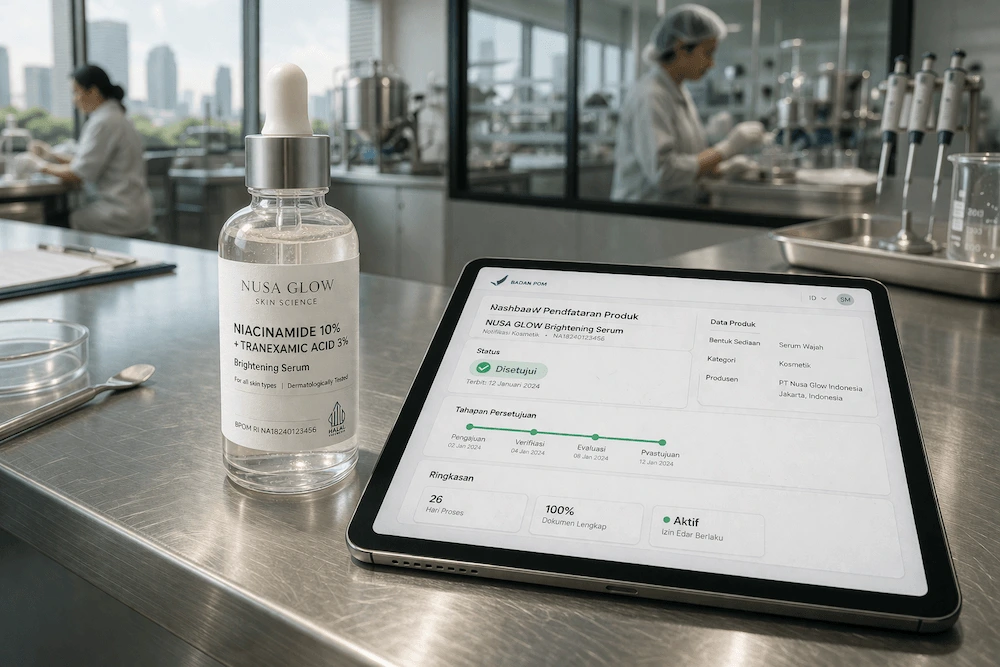
All cosmetic product registration in Indonesia is conducted through the Notifkos (National Notification of Cosmetics) platform, a digital system managed by BPOM. The Notifkos portal replaced the older, paper-based registration process with a streamlined notification procedure. Here is how it works from start to finish.
Step 1: Account and Manufacturer Registration
The local entity (the Notification Holder) must register on the Notifkos system. Simultaneously, the foreign manufacturer must be registered and verified in BPOM’s database. Both registrations must be completed before any product notification can be submitted.
Step 2: Internal Formula and Label Compliance Review
Before uploading anything to the portal, the applicant must conduct a thorough internal review. The formula is checked against BPOM’s restricted and prohibited ingredient lists, including concentration limits for UV filters, preservatives, and colorants. The proposed label is reviewed for compliance with language requirements, mandatory information fields, and INCI ingredient listings.
Step 3: Digital Submission via the Notifkos Portal
Once internal compliance is confirmed, all required documents are uploaded to the portal. Required submissions typically include the CFS, the complete quantitative and qualitative formula, product specifications, and proposed label artwork.
Step 4: Payment of Government Fee (PNBP)
A non-refundable administrative fee is paid following successful document upload. Fees vary by product origin: approximately IDR 1,500,000 for products from outside the ASEAN region, and approximately IDR 500,000 for products manufactured within ASEAN member countries. Processing will not proceed until payment is confirmed.
Step 5: BPOM Verification
BPOM reviews submitted data and documents. The system operates on a self-declaration principle, but BPOM retains the right to verify all submitted claims. Standard verification takes approximately 14 working days. Simpler categories, such as perfumes and basic fragrances, are typically processed within 3 working days.
Step 6: Issuance of the NA Number
Upon approval, the product receives an NA Number (for example, NA12345678910), an 11-digit notification number that serves as its official market authorization. This number must be displayed on product packaging and is valid for three years, after which a renewal application must be submitted.
Cosmetic Product Registration in Indonesia Does Not End at Approval
Receiving the NA Number is a significant milestone, but it is the beginning of an ongoing regulatory relationship, not the conclusion of one. Indonesian law places substantial post-market responsibilities on the Notification Holder, and BPOM actively monitors compliance.
Mandatory Indonesian-Language Labeling
All product packaging, whether primary or secondary, must carry essential information in Bahasa Indonesia. The following elements are mandatory on every label:
• The NA Number (Nomor Notifikasi)
• Full ingredient list (INCI names are acceptable, with Indonesian translations where required)
• Directions for use
• Name and address of the Notification Holder in Indonesia
• Net content (volume or weight)
• Batch/lot number and expiry date (or PAO symbol)
• Required warning statements, if applicable to the formulation
SKI: Import Clearance for Every Shipment
For each physical shipment of a notified product entering Indonesia, the local importer must obtain a Surat Keterangan Impor (SKI), or Import Clearance Letter, from BPOM prior to the goods arriving at the customs checkpoint. Customs officials verify the SKI against the shipment’s details, including the NA number, product description, and quantity. Shipments without a valid SKI are detained at the port of entry.
Adverse Event Reporting and Safety Monitoring
The Notification Holder bears direct legal responsibility for pharmacovigilance. This includes maintaining a system to track, document, and evaluate any reports of adverse reactions or quality complaints from Indonesian consumers, distributors, or healthcare professionals. Severe or unexpected adverse events must be reported to BPOM within mandated timelines. Failure to maintain an effective safety monitoring system can result in product recall, suspension of the NA Number, or revocation of market authorization.
BPOM Certification for Halal Compliance: What Foreign Brands Must Know
Mandatory Halal certification is now one of the most transformative requirements in cosmetic product registration in Indonesia. This requirement is not a soft recommendation; it is a hard prerequisite for distribution and sale in the Indonesian market.
Halal certification is issued by BPJPH (Badan Penyelenggara Jaminan Produk Halal), Indonesia’s official Halal product guarantee body. The certification process involves a full audit of the product’s entire supply chain, including raw material sourcing, manufacturing processes, packaging materials, and storage conditions, to verify adherence to Islamic dietary and ethical principles.
For international manufacturers, this typically means:
• Reviewing all raw materials for animal-derived ingredients or alcohol content
• Engaging with an accredited Halal auditing body in the country of manufacture
• Preparing a comprehensive supply chain disclosure for the BPJPH audit
• Building Halal compliance into the product development and sourcing process from the earliest stages
Companies that treat Halal certification as an afterthought consistently face delays. Those that integrate it into their pre-submission planning move through the process far more smoothly.
Proactive Ingredient Compliance: The Pre-Check Protocol
BPOM Regulation No. 25 of 2025 introduced a significantly revised list of restricted and prohibited ingredients for cosmetic products. This regulation is the governing standard for ingredient compliance in 2026, and it is the most common source of technical rejections during the registration process.
Before any product dossier is submitted to BPOM, a pre-check protocol should be completed by a qualified laboratory or authorized regulatory consultant. This protocol involves:
1. Cross-referencing every ingredient in the formulation against the annexes of Regulation No. 25 of 2025, identifying any prohibited substances and verifying that restricted ingredients are within permitted concentration limits.
2. Concentration verification for all restricted ingredients, confirming that the concentrations stated on the Certificate of Analysis and the formulation sheet match the regulatory maximums.
3. ドキュメントの準備 to ensure all ingredient safety data is correctly formatted according to BPOM’s current requirements, reducing the likelihood of a deficiency notice or outright rejection.
Skipping this step is one of the most avoidable and costly mistakes a registrant can make. Rejections based on ingredient non-compliance restart the review timeline and generate additional administrative costs.
Conclusion: Cosmetic Product Registration in Indonesia Rewards Preparedness
The Indonesian beauty market offers exceptional commercial potential. But cosmetic product registration in Indonesia demands the same rigor and foresight that the market’s size and complexity deserve. From selecting the right local entity structure and passing the BPOM audit, to completing the Notifkos notification process and maintaining post-approval obligations, every stage of this process is governed by clear rules and active enforcement.
The most successful market entrants are those who treat BPOM registration not as a bureaucratic hurdle to clear once, but as an ongoing compliance discipline. With the 2026 regulatory updates firmly in place, including mandatory Halal certification and enhanced ingredient standards, foreign brands must enter the Indonesian market with current knowledge, reliable local partnerships, and documentation that is thorough from day one. The preparation required is significant, but so is the reward of accessing one of Southeast Asia’s most dynamic consumer markets.

記事執筆者
フセイン・H・マシュア博士(医学博士)
Hussein is a licensed medical doctor and healthcare executive with 10+ years in pharma, medical devices, and digital health. At Business Hub Asia, he guides global firms through MoH, BPOM, and CDAKB registration, market access, and regulatory compliance across Southeast Asia.
市場の洞察を常に最新の状態に保つ
よくある質問
What is BPOM and why is its certification required for cosmetics in Indonesia?
BPOM stands for Badan Pengawas Obat dan Makanan, Indonesia’s National Agency of Drug and Food Control. It is the sole regulatory authority responsible for approving cosmetic products sold in Indonesia. Any cosmetic product distributed in Indonesia without a BPOM notification number (NA Number) is considered illegal and may be confiscated. BPOM certification ensures the product meets Indonesian safety, ingredient, and labeling standards before it reaches consumers.
Can a foreign company register cosmetics directly with BPOM without a local partner?
No. Indonesian regulations explicitly prohibit foreign companies from holding a cosmetic notification directly. All regulatory responsibility must rest with an Indonesian-registered entity, either a locally established subsidiary (PT PMA) or a licensed local representative appointed through a Power of Attorney. The local entity becomes the official Notification Holder and is legally accountable for the product’s compliance throughout its market life.
How long does cosmetic product registration in Indonesia typically take?
Once all documentation is correctly prepared and uploaded to the Notifkos portal, BPOM’s standard review timeline is approximately 14 working days. Simpler categories such as perfumes may be processed in as few as 3 working days. However, the preparation phase, including entity setup, the BPOM physical audit, document procurement, Halal certification, and ingredient compliance review, can add several months to the overall timeline. Companies should plan for a total process of 4 to 9 months from initial preparation to receiving the NA Number.
Is Halal certification mandatory for all cosmetic products sold in Indonesia?
Halal certification has become a mandatory requirement for cosmetic products sold in Indonesia, with phased implementation that intensified from 2026 onward. The certification is issued by BPJPH and requires a full supply chain audit. Products containing animal-derived ingredients or alcohol are subject to particular scrutiny. Foreign brands are strongly advised to begin the Halal certification process in parallel with their BPOM registration preparations, as it often takes several months to complete and cannot be expedited easily.
What is the NA Number and what does it mean for a cosmetic product?
The NA Number (Nomor Notifikasi) is the official 11-digit market authorization number issued by BPOM upon successful product notification. It signifies that the product has been reviewed and approved for distribution and sale in Indonesia. The NA Number must be printed on the product’s packaging and is valid for three years. Without a valid NA Number, a cosmetic product cannot legally be sold in the Indonesian market.
What happens if an ingredient in a foreign cosmetic formula is restricted or banned by BPOM?
If a product contains an ingredient that is prohibited or exceeds the maximum concentration limits set out in BPOM Regulation No. 25 of 2025, the registration application will be technically rejected. This rejection resets the review timeline and generates additional costs. To avoid this outcome, all formulations must be cross-referenced against the current BPOM ingredient annexes before submission. In cases where a restricted ingredient exceeds the permitted limit, the manufacturer will need to reformulate the product before reapplying.
What is an SKI and is it required for every shipment of registered cosmetics?
Yes. A Surat Keterangan Impor (SKI), or Import Clearance Letter, is a BPOM-issued document that must be obtained before each physical shipment of a registered cosmetic product enters Indonesia through customs. Indonesian customs officials verify the SKI against the shipment’s contents, including the product’s NA Number, quantity, and description. If an SKI is absent or does not match the shipment, the goods will be held at the port until the issue is resolved. The local Notification Holder is responsible for securing the SKI in advance of every consignment.
私たちのチームに連絡してください
弊社が貴社の会社設立や拡大にどのように貢献できるかお知らせください。
自信を持って東南アジア市場への参入を始めましょう
Business Hub Asiaは、事業ライセンスや製品登録から従業員管理まで、インドネシア、ベトナム、フィリピンの規制遵守をお手伝いします。効率的で正確、そしてビジネス重視のアプローチでサポートいたします。
免責事項
このウェブサイトで提供されるコンテンツは、 PT. ビジネスハブアジア (“「“私たちは"、 または "私たち(以下「本サイト」といいます)は、一般的な情報提供のみを目的としています。掲載情報の正確性と最新性を確保するため、当社はあらゆる努力を払っておりますが、本サイトに掲載されているコンテンツ、製品、またはサービスの完全性、正確性、信頼性、適合性、または可用性について、明示的または黙示的を問わず、いかなる表明または保証も行いません。当該情報への依拠は、ユーザーご自身の責任において行っていただきますようお願いいたします。
私たちは 民間の独立団体 そして 提携関係にない, 承認者、 または 代理として行動する インドネシア共和国政府、その省庁、機関、または公式に任命された代表者。本ウェブサイトは ない 以下を含むがこれに限定されない、政府の公式文書またはサービスを提供、提供、または宣伝すること:
-
企業識別番号 (Nomor Induk Berusaha – NIB);
-
税金の還付または払い戻し。
-
滞在許可証または電子渡航認証。
-
パスポートまたはその他の入国関連書類。
かかるサービスへの言及は、一般的な情報提供のみを目的としており、公式サービスの提供または促進として解釈されるべきではありません。
当社は、お客様の個人情報を以下のとおり保護することに尽力しております。 2022年個人情報保護法第27号当ウェブサイトを通じて収集された個人情報は、[プライバシーステートメント]に明記されている目的のために処理されます。いかなる状況においても、個人データを販売または悪用することはありません。
本ウェブサイトにアクセスし、本ウェブサイトを利用することにより、お客様は本免責事項に定められた条件を承認し、同意するものとします。また、お客様は本ウェブサイトおよび提供される情報を、適用される法令を遵守し、責任を持って利用することに同意するものとします。
この免責事項に関する詳しい情報やご質問については、お問い合わせページに記載されているチャネルを通じて当社までご連絡ください。
あなたも気に入るかもしれない
東南アジアでのビジネスに関する最新の洞察、ガイド、記事で最新情報を入手してください。
事業許可証
Navigating BPOM Certification in Indonesia: A Comprehensive Approach to Product Safety and Quality
Dr. Hussein H. Mashhour, MD • 3月 25, 2026
事業許可証
OSSインドネシア:外国人投資家のための完全ガイド

Tjhia Edy Tarlesno、SH、LLM。 • 2026 年 3 月 6 日
事業許可、ガイド
Surat Izin Pengusahaan Air Tanah: 取得までのステップバイステップ

ファフリ・ラマンダ・プトラ • 2026年3月3日