







Manufacturing in FTZ Batam: Real Costs, Required Permits, and What to Prepare Before You Set Up
May 5, 2026
•
16 minutes read
Content
FTZ Batam has been attracting foreign manufacturers since the 1990s, but the conversation has changed in 2025 and 2026. US tariffs on Chinese goods, rising production costs across China, and a new Indonesia-US trade framework have given manufacturers a fresh set of reasons to take Batam seriously as a production base.
The challenge is not finding reasons to consider Batam. It is understanding what the setup process actually involves, which licences are genuinely required, and where the structural limits of the FTZ model sit. This article walks through all three.
The Trade Pressure That Is Pushing Manufacturers to Recalculate
The US-China trade relationship has gone through multiple escalation cycles since 2018. By early 2025, effective tariff rates on a broad range of Chinese goods had reached levels that made production-base diversification not just attractive, but financially necessary for many exporters supplying the American market.
In November 2025, the two governments extended a tariff reduction framework through November 2026. That did not resolve the underlying tension. Manufacturers who moved production bases early have already locked in cost advantages their slower competitors are still trying to close.
| Indonesia-US Reciprocal Trade Agreement, February 2026
Indonesia and the United States signed a bilateral trade framework in February 2026 that caps the incremental US reciprocal tariff surcharge on most Indonesian-origin goods at no higher than 19 percent. Certain listed product categories receive zero reciprocal tariff treatment. For manufacturers choosing between ASEAN production locations, this converts a previously open-ended tariff risk into a capped, estimable worst case. It is a structurally significant development for anyone building a cost model around Indonesia as an export base. |
Indonesia’s goods exports to the US reached an all-time high of USD 3.1 billion in July 2025. Net trade with the US generated a USD 12.1 billion gain for Indonesia in the first seven months of 2025. These figures give manufacturers a concrete baseline for assessing the trade momentum behind an Indonesia production decision.
What FTZ Batam Actually Offers Manufacturers: The Cost Breakdown
The headline FTZ advantages are frequently cited. The specifics are where manufacturers need to do their own calculation. Here is what the cost structure looks like in practice, not in a brochure.
Labour and Land
- Labour costs: Manufacturing wages in Batam average approximately USD 250 per month. This is competitive with Central Java and below Vietnam’s established manufacturing corridors, where 2026 wage data shows monthly averages of USD 300 to 350 in the Ho Chi Minh City and Binh Duong industrial zones.
- Industrial land lease: Rates in Batam’s industrial zones range from USD 35 to USD 70 per square metre per year. This sits significantly below Singapore’s industrial land costs and is competitive against Johor’s Iskandar corridor.
- Ready-built factory units: Available for lease (not only purchase) at Batamindo and several other estates. This matters for manufacturers running a pilot operation before committing to a greenfield build.
Tax and Customs Incentives
- Import duty exemption: Goods imported into the FTZ for use in manufacturing are exempt from import duties by default. No per-shipment application is required.
- VAT (PPN) exemption: Goods entering the FTZ are not subject to VAT, provided the correct customs documents are filed and the DJP endorsement (PP FTZ-03) is obtained. Without that endorsement, the exemption does not apply automatically.
- PPnBM (luxury goods tax) exemption: Also waived within the FTZ framework for qualifying goods.
- Tax holiday access: Qualifying investments above IDR 100 billion are eligible for corporate income tax reductions of 50 to 100 percent under the national Tax Holiday programme.
- No export quotas: Products manufactured in FTZ Batam and exported overseas face no export quotas or restrictions.
| Pro Tip Labour costs in Vietnam’s core manufacturing zones are rising faster than in Batam. By 2026, established corridor wages in Vietnam have moved closer to USD 300 to 350 per month. Companies that chose Vietnam in 2019 or 2020 for the labour cost advantage may find that gap significantly narrower than expected when they re-run their numbers today. |
The Singapore Proximity Factor
Batam is 20 kilometres from Singapore, roughly a 45-minute ferry crossing. This is not just a logistical detail. It defines how many Singapore-based multinationals structure their regional operations.
In the first half of 2025, Singapore companies invested IDR 7.9 trillion in Batam, representing about 69 percent of the region’s total foreign direct investment. Many firms use a twin-location model: Singapore holds headquarters, finance, and R&D, while Batam runs manufacturing or logistics.
The Actual Permits and Licences Required to Operate in FTZ Batam
This is the section that most investment guides skip or oversimplify. Operating in FTZ Batam requires more than just an NIB from OSS-RBA. There is a specific set of permits from BP Batam’s licensing system (IBOSS) that unlock the FTZ benefits, and missing any of them has direct operational and financial consequences.
The Complete Permit Stack
| License / Permit | Issuing Authority | Who Needs It | Legal Basis |
| NIB (Nomor Induk Berusaha) | OSS-RBA (BKPM / DPMPTSP) | All PT PMA companies without exception | GR No. 28/2025 (PP 28/2025) |
| IUK LDP (Izin Usaha Kawasan Luar Daerah Pabean) | BP Batam via IBOSS | Businesses importing goods from outside Indonesia into the FTZ | Perka BP Batam No. 24 & 25 Tahun 2021 |
| IUK TLDDP (Izin Usaha Kawasan Tempat Lain Dalam Daerah Pabean) | BP Batam via IBOSS | Businesses moving goods from FTZ into mainland Indonesia (TLDDP) | Perka BP Batam No. 24 & 25 Tahun 2021 |
| IUK K3S (Izin Usaha Kawasan Kontraktor Kontrak Kerjasama) | BP Batam via IBOSS | Production sharing / KKS contractors operating inside the FTZ | Perka BP Batam No. 24 & 25 Tahun 2021 |
| CEISA 4.0 System Access | Directorate General of Customs (DJBC) | Any business filing PP FTZ-01 / FTZ-03 customs documents | PMK 113/2024 |
| PP FTZ-03 Endorsement (DJP) | Directorate General of Taxes (DJP) | Businesses claiming PPN and PPnBM exemptions on goods entering the FTZ | PMK 34/PMK.04/2021 |
| PBG (Persetujuan Bangunan Gedung) | BP Batam PTSP | Any company constructing or fitting out a building on BP Batam-allocated land | GR No. 28/2025; PP No. 41/2021 |
| Environmental Permit (Persetujuan Lingkungan) | BP Batam PTSP / KLHK | Manufacturers with processes that generate environmental impact (AMDAL / UKL-UPL) | UU No. 32/2009; PP No. 22/2021 |
| Land Allocation Letter (Surat Keputusan Alokasi Lahan) | BP Batam | Any company that needs land or a factory unit within BP Batam’s jurisdiction | PP No. 25/2025; PP No. 41/2021 |
| LKPM Reporting Activation | BKPM via OSS-RBA | All PT PMA companies from Day 1 of business activity | BKPM Regulation No. 5/2025 |
Sources: BP Batam PTSP / IBOSS (Indonesia Batam OSS) / PMK 34/PMK.04/2021 / BKPM Regulation No. 5/2025
Understanding the Three Types of Izin Usaha Kawasan (IUK)
The Izin Usaha Kawasan (IUK), or Zone Business Licence, is the BP Batam-specific permit that authorises a company to move goods in and out of the FTZ. It is issued through the IBOSS platform based on Peraturan Kepala BP Batam No. 24 and 25 of 2021.
There are three variants, and each applies to a different trade direction. Choosing the wrong type, or applying for only one when the operation requires two, is one of the most common compliance errors in Batam FTZ setup.
- IUK LDP (Luar Daerah Pabean): This permit covers importing goods from outside Indonesia’s customs territory into the Batam FTZ. Any manufacturer importing raw materials, machinery, or components from overseas needs this licence. Without it, goods arriving from abroad cannot be cleared under the FTZ duty exemption framework.
- IUK TLDDP (Tempat Lain Dalam Daerah Pabean): This permit covers moving goods from the FTZ into mainland Indonesia (the domestic customs territory, or TLDDP). Manufacturers who sell any portion of their output into the Indonesian market, even small volumes, require this licence in addition to the IUK LDP.
- IUK K3S (Kontraktor Kontrak Kerjasama): This is a specialist licence for production sharing contractors operating under a KKS agreement within the FTZ. It applies primarily to the oil, gas, and energy sector.
| The CEISA 4.0 Access Requirement: Often Overlooked
To submit PP FTZ-01 and FTZ-03 customs documents, a company must have registered system access to CEISA 4.0, the Directorate General of Customs’ digital customs clearance platform. This access is not granted automatically upon obtaining the NIB or the IUK. It requires a separate registration process with the local Customs Office (Kantor Pabean). Companies that have not completed this registration cannot submit customs documents electronically, which effectively blocks all import-export transactions. This step needs to be completed before the first shipment arrives, not after. |
The DJP Endorsement on FTZ-03: A Step Most Guides Miss
Goods entering the Batam FTZ are eligible for PPN and PPnBM exemptions, but only if accompanied by a PP FTZ-03 document that has been endorsed by the Directorate General of Taxes (DJP). Without this endorsement, the PPN exemption does not apply, even for goods entering a legitimate FTZ operation.
The PP FTZ-03 must be filed at the local Customs Office before the goods arrive. The DJP endorsement process confirms that the goods are entering a qualifying FTZ business. This step is governed by PMK 34/PMK.04/2021, and it requires that the receiving company already has its IUK LDP in place.
| Pro Tip The most efficient sequencing for FTZ Batam setup is: (1) OSS-RBA registration and NIB; (2) IUK application through IBOSS; (3) CEISA 4.0 customs access registration; (4) Land or factory unit agreement; (5) PBG building permit if construction is required; (6) Environmental permit if applicable. Running these steps out of order, or in parallel without understanding dependencies, is the single most common cause of delays in Batam FTZ setup timelines. |
Which Sectors Are Actually Moving Into FTZ Batam in 2025 and 2026
The Q1 2026 investment data from BP Batam provides the clearest signal of where manufacturing demand is actually concentrating. Machinery and electronics led at 23.65% of total investment realization, followed by chemicals and pharmaceuticals at 21.18%.
The chemicals and pharma surge is notable because it represents real industrial diversification. Batam’s investment story is no longer solely about electronics assembly and shipbuilding. The Indonesian Ministry of Industry has identified 19 industrial zones in Batam as target sites for manufacturer relocations from China, covering electronics, textiles, footwear, and automotive industries.
Sources: The Jakarta Post, April 2026 / Batam News Asia, January 2025
The Existing Manufacturing Ecosystem
Batam hosts established manufacturing operations for Apple, TDK Electronics, Casio, Panasonic, Epson, Fujitech, and Infineon. Entering Batam means entering a functional industrial ecosystem with existing logistics networks, supplier relationships, and technical workforce pipelines, not a greenfield territory.
One area requiring careful planning is solar panel manufacturing. Batam’s FTZ status attracted Chinese solar assemblers seeking to avoid US tariffs in 2025, which drew scrutiny from US customs authorities. Genuine value-adding production with solid rules-of-origin documentation is essential for any manufacturer in this space.
Source: Japan Times, July 2025
Industrial Estate Options: Where in FTZ Batam Should Manufacturers Go?
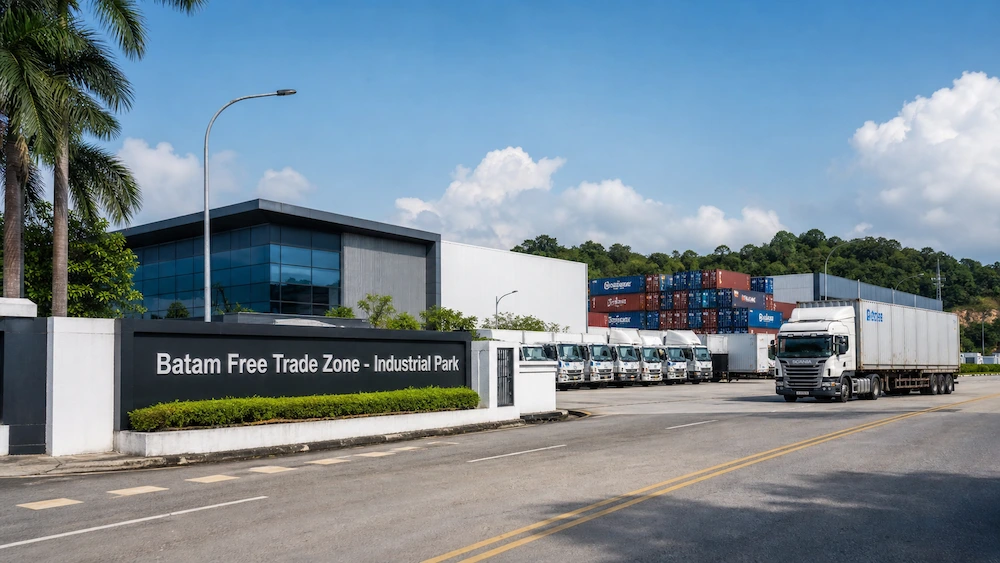
FTZ Batam spans the entire island and includes eight major industrial estates plus sector-specific zones. Each has a different infrastructure profile, sector focus, and cost structure. The right choice depends on the specific industry, factory size, timeline, and budget.
| Park / Estate | Size | Primary Sectors | Key Advantage |
| Batamindo Industrial Park | 360 ha | Electronics, ICT, precision moulding | MNC-grade infrastructure, Singapore G-to-G origin, 35% ICT tenants |
| Kabil Ind. Estate (KIIE) | 540 ha | Oil and gas, heavy industry, energy | Coastal location, suitable for large-footprint industrial operations |
| Tanjung Uncang / Drydock | 75 ha | Shipbuilding, offshore fabrication | Backed by Ministry of Industry; ready-built factories available |
| Nongsa Digital Park SEZ | SEZ within FTZ | Data centres, digital, BPO, animation | National Strategic Project; submarine cable access to Singapore |
| Panbil Industrial Estate | Integrated township | Light industry, logistics, commercial | Residential and commercial facilities within the estate boundary |
Batamindo Industrial Park: The Benchmark
Established in 1990 under an Indonesia-Singapore government-to-government agreement, Batamindo Industrial Park is a 360-hectare estate managed by PT Batamindo Investment Cakrawala, a subsidiary of Gallant Venture Ltd (Salim Group). It hosts 74 companies, with ICT industries at 35% of tenants and precision and moulding at 22%.
The park includes onsite power generation, water and wastewater treatment, fibre optic connectivity, and a one-stop service for company setup and licensing. Ready-built factory units are available for lease, which matters for manufacturers who need to reach operational status quickly.
Step-by-Step: The FTZ Batam Setup Process for Foreign Manufacturers
Setting up a foreign-owned manufacturing company (PT PMA) in FTZ Batam involves two distinct licensing tracks that run in parallel. Understanding the dependencies between them is what separates a smooth setup from a delayed one.
Step 1: OSS-RBA National Registration
Under Government Regulation No. 28 of 2025, all companies must register through the OSS-RBA platform before any other permits can be obtained. This produces the NIB, the Business Identification Number that underpins all subsequent licensing in Indonesia.
The OSS-RBA system consolidated land use, environmental, construction, and operational permits into a single digital platform. The risk classification assigned at this stage (low, medium, or high risk) determines which additional permits are required before a business activity can legally commence.
Step 2: BP Batam FTZ-Specific Permits via IBOSS
After obtaining the NIB, manufacturers operating in the FTZ must apply for their Izin Usaha Kawasan (IUK) through IBOSS, the Indonesia Batam Online Single Submission system managed by BP Batam. This is the step that unlocks FTZ benefits.
Most manufacturers importing from abroad and potentially selling some goods domestically will need both IUK LDP and IUK TLDDP. Applying for only one and discovering the gap during a customs transaction is a costly and time-consuming correction.
Step 3: CEISA 4.0 Customs System Registration
CEISA 4.0 access must be registered separately with the local Customs Office before any import or export transaction can be submitted electronically. This includes registration of the company’s customs user credentials and the designation of any approved customs agent (PPJK) if the company uses a third-party customs broker.
This step is often left until a shipment is imminent. That timing creates unnecessary risk. CEISA 4.0 registration should be completed during the setup phase, not when the first container is already in transit.
Step 4: Land, Building Permits, and Environmental Clearance
If the company is building its own facility rather than leasing a ready-built unit, the land allocation letter (SK Alokasi Lahan) from BP Batam must be obtained first. The PBG building permit follows once the land allocation is confirmed. Environmental permits apply to operations with significant environmental impact and require either an AMDAL (full environmental impact assessment) or a UKL-UPL (lighter environmental management document), depending on the scale and type of manufacturing.
| KBLI Classification: Get This Right at the Start
The KBLI (Indonesian Standard Business Classification) code selected at company incorporation defines the permitted scope of business activities. For manufacturers, an overly narrow KBLI can block the import of specific raw material categories or restrict the types of buyers the company can legally supply. Amending a KBLI after incorporation requires a formal OSS-RBA amendment process and can affect active permits during the transition. This is a decision that is far less expensive to get right at the start than to correct later. |
Ongoing Compliance: The Regular Obligations
- LKPM quarterly reports: Investment Activity Reports due on the 15th of April, July, October, and January under BKPM Regulation No. 5/2025.
- Monthly WHT filings: PPh 21 for employee income tax withholding and PPh 23/26 for supplier and service provider payments.
- Monthly VAT reports: Required even within the FTZ for certain transaction types and for any sales into the domestic market.
- BPJS contributions: Monthly employer contributions to BPJS Kesehatan and BPJS Ketenagakerjaan.
- Customs document compliance: All import and export transactions must follow the updated customs procedures under PMK 113/2024, effective March 2025.
Sources: BKPM Regulation No. 5/2025 / PMK 113/2024
More from our blog: Batam FTZ in 2026: What the Record Investment Surge Actually Means for Incoming Foreign Businesses
FTZ Batam vs. the Alternatives: An Honest Comparison
Any serious decision about manufacturing in FTZ Batam involves comparing it against the other locations on the shortlist. Below is a factual side-by-side overview across the factors that actually determine manufacturing costs.
| Factor | FTZ Batam | Vietnam | Johor / JSSEZ | Java (Non-FTZ) |
| Labour cost (monthly avg.) | approx. USD 250 | USD 300-350* | USD 350-400 | USD 250-300 |
| Import duty on inputs | Exempt (default) | Not blanket-exempt | Partial, SEZ only | Standard rates |
| FTZ blanket coverage | Entire island | Zone-specific only | Zone-specific only | None |
| Singapore proximity | 20 km / 45 min ferry | 1,700+ km | 1 km / land bridge | 1,000+ km |
| Domestic market access | Customs barrier applies | Open (ASEAN) | Open (ASEAN) | Direct access |
| US tariff on exports | Capped at 19% (RTA 2026) | Negotiated rate | Via Malaysia rate | Capped at 19% (RTA) |
| Tech / digital ecosystem | Nongsa Digital Park SEZ | Limited | Growing (JSSEZ) | Jakarta-centric |
* Vietnam 2026 labour estimates reflect Ho Chi Minh City and Binh Duong corridor averages. Northern provinces (Bac Ninh, Hung Yen) remain lower at USD 220 to 260.
FTZ Batam vs. Vietnam
Vietnam’s core structural advantage is its FTA network: 17 active agreements as of March 2026, including CPTPP and EVFTA (EU-Vietnam). This gives Vietnamese-origin goods direct duty-free access to markets that Indonesian-origin goods do not automatically reach.
Batam’s advantage is the island-wide FTZ duty exemption on inputs, the Singapore operational proximity, and the 2026 Indonesia-US trade framework. For products where input costs are a significant share of total cost, the import duty exemption on raw materials and components can be more valuable than Vietnam’s downstream FTA advantages.
FTZ Batam vs. Johor / Johor-Singapore SEZ
The JSSEZ offers competitive incentives and Malaysia’s own FTA network, and it shares Singapore proximity with Batam. Johor’s advantage is land border connectivity with Singapore. Batam’s advantage is the island-wide FTZ coverage versus Johor’s zone-specific incentive model.
Most analysts view the two as complementary rather than directly substitutable. They tend to serve different sector profiles, with Johor stronger in data centres and Singapore-adjacent services, and Batam stronger in traditional manufacturing and export-oriented production.
| Pro Tip The cleanest way to compare FTZ Batam against Vietnam or Johor is to build a product-specific landed cost model. Inputs as a percentage of total product cost, export destination tariff rates, labour intensity, and logistics routes all affect which location produces the best unit economics for a specific product. A general country-level comparison rarely produces a clear answer. |
The Real Risks for Manufacturers in FTZ Batam
The FTZ Batam investment case is credible. So are the operational risks. Companies that enter without factoring these into their planning frequently encounter delays and unexpected costs that the FTZ incentives do not fully offset.
Risk 1: The Domestic Market Customs Boundary
This point bears repeating clearly. Goods manufactured in FTZ Batam and sold into mainland Indonesia are treated as imports from abroad. They attract import duties and VAT as if they were entering Indonesia from an overseas supplier.
This is not a regulatory grey area or a detail that will be reformed away. It is the structural design of an FTZ as a separate customs territory. Manufacturers whose revenue model includes significant domestic Indonesian sales need to factor this into their unit economics before committing to Batam.
Risk 2: Port Infrastructure Limits
Batu Ampar Port handles approximately 1.2 million TEU per year and is Batam’s primary container gateway. Its current draft limitation of 10.5 metres prevents direct calls by post-Panamax vessels. Large shipments require transhipment through Singapore, adding freight cost and transit time.
The Phase 1 expansion has lifted theoretical capacity to 1.5 million TEU, but dredging to 12 metres remains unfunded as of early 2026. High-volume exporters need to build the Singapore transhipment cost into their logistics model from the start.
Risk 3: Skilled Technical Labour Constraints
General manufacturing labour is available and competitively priced in Batam. Senior technical roles in electronics engineering, precision machining, and factory automation are a different matter. The local vocational and university pipeline does not yet match the demand from the island’s expanding high-tech manufacturing base.
Companies in technology-intensive sectors should plan for a mix of locally recruited entry-level operators and transferred or expatriate specialists for senior technical positions. KITAS/KITAP immigration procedures for expatriate staff should be mapped into the setup timeline before the first technical hire arrives.
Risk 4: Rules-of-Origin Compliance Scrutiny
With Batam positioned as a destination for manufacturers relocating from China, US customs authorities have increased examination of rules-of-origin claims for Indonesian-origin goods entering the US. Operations that assemble or minimally process Chinese-origin inputs without genuine value transformation are most exposed.
Legal teams reviewing supply chain structures for Batam operations should treat rules-of-origin compliance as a core structural issue, not a documentation formality. The risk is not theoretical: it has already resulted in enforcement actions against solar-related operations in 2025.
| Key Takeaways: Manufacturing in FTZ Batam in 2026
1. FTZ Batam requires two licensing tracks: OSS-RBA for the NIB, and BP Batam IBOSS for the Izin Usaha Kawasan (IUK). Both are required before operations can begin. |

Article By
Nurmia Dwi Agustina, S.E., MBA
Nurmia is a corporate services expert with 15+ years of experience in Southeast Asia. Co-founder of Cekindo and former COO of InCorp Indonesia, she now leads Business Hub Asia’s regional operations, guiding companies through licensing, compliance, and growth.
Stay updated with market insights
Get in Touch With Our Team
Let us know how we can assist with your company formation or expansion.
Start Your SEA Market Entry with Confidence
Business Hub Asia is ready to help you navigate Indonesia, Vietnam, and Philippines regulations, from business licensing and product registration to workforce management. With an efficient, accurate, and business-focused approach.
Disclaimer
The content provided on this website is published by PT. Bisnis Hub Asia (“we“, or “us“) for general informational purposes only. While every effort is made to ensure the accuracy and timeliness of the information presented, we make no representations or warranties, express or implied, as to the completeness, accuracy, reliability, suitability, or availability of any content, products, or services described on this website. Any reliance placed on such information is strictly at the user’s own risk.
We are a private, independent entity and are not affiliated with, authorized by, or acting on behalf of the Government of the Republic of Indonesia, its ministries, agencies, or any officially appointed representatives. This website does not provide, offer, or promote any official government documents or services, including but not limited to:
-
Business identification numbers (Nomor Induk Berusaha – NIB);
-
Tax refunds or rebates;
-
Stay Permit or electronic travel authorizations;
-
Passports or other immigration-related documents.
Any references to such services are provided solely for general informational purposes and should not be construed as an offer or facilitation of official services.
We are committed to ensuring the protection of your personal data in accordance with Law No. 27 of 2022 on Personal Data Protection. Any personal information collected through this website will be processed for the purposes clearly stated in our [Privacy Statement]. We do not sell or misuse personal data under any circumstances.
By accessing and using this website, you acknowledge and agree to the terms set out in this Disclaimer. You further agree to use this website and the information provided responsibly and in compliance with applicable laws and regulations.
For further information or questions regarding this Disclaimer, please contact us via the channels provided on our Contact page.
You May Also Like
Stay informed with our latest insights, guides, and articles on doing business in Southeast Asia.
Company Registration
Batam FTZ in 2026: What the Record Investment Surge Actually Means for Incoming Foreign Businesses
Nurmia Dwi Agustina, S.E., MBA • May 5, 2026
Company Registration
Ultimate Beneficial Ownership (UBO) in Indonesia: A Complete Guide for Foreign Investors
Nurmia Dwi Agustina, S.E., MBA • March 10, 2026
Company Registration
Company Setup in Indonesia: The 2026 Strategic Investor’s Guide

Daris Salam • February 27, 2026